The Frank Report

The truth is always fair

Frank Report
The truth is always fair

Judge Dismisses Ambrose Lawsuit Over False Poverty Claim
04/20/2026  |  Frank Parlato
Judge Dismisses Ambrose Lawsuit Over False Poverty Claim
SharefXin

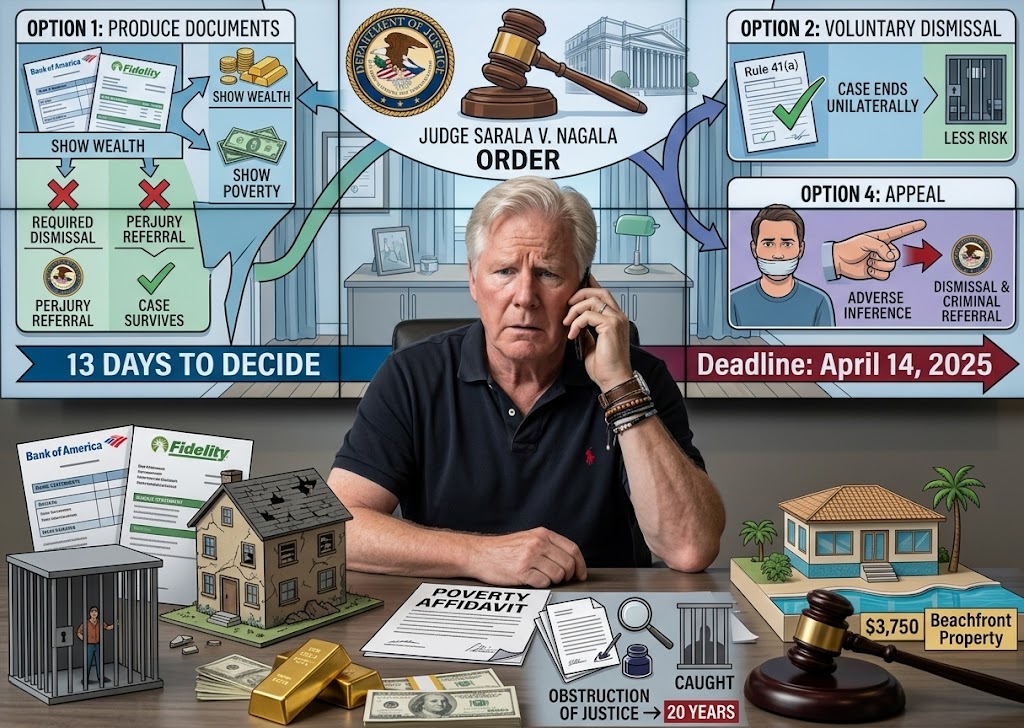
A federal judge dismissed Christopher Ambrose’s defamation lawsuit against psychiatrist Dr. Bandy X. Lee on April 15, 2026, finding that his sworn claim of poverty was untrue — and that the law left her no choice but to throw the case out.

Judge Sarala V. Nagala’s order, filed in U.S. District Court in Connecticut, came one day after Ambrose submitted his financial records under seal. The judge reviewed them and found they directly contradicted the poverty affidavit Ambrose had filed in March 2025 to avoid paying a $405 filing fee.

The case is dismissed without prejudice, meaning Ambrose may refile — if he pays the fee this time.

What He Swore and What He Had

In his March 2025 in forma pauperis affidavit, Ambrose swore he had $294.98 in cash, no income from any source in the prior twelve months, and no stocks, bonds, or securities.

The financial records he submitted to the court told a different story.

His Fidelity IRA showed substantial stock holdings — directly contradicting his sworn statement that he owned no stocks, bonds, or securities.

His supplemental declaration, which the judge ordered unsealed, admitted he received a residual royalty payment of $169.45 in November 2024. That contradicted his sworn claim of zero income from business, profession, self-employment, or any other source in the twelve months before he filed.

The judge was direct. Ambrose’s explanations did not hold up. He argued that he thought retirement accounts were excluded from reportable assets because federal student aid guidelines treat them that way. 

The judge rejected this: the IFP application posed a direct question about stocks, bonds, and securities, with no such carve-out. She also noted that Ambrose is a suspended attorney and is not entitled to the same leniency afforded to ordinary pro se litigants unfamiliar with court procedures.


The Asset Liquidation Document

Among the documents Ambrose submitted under seal was one he labeled “Summary of Asset Liquidation and Corresponding Bank Deposits” — his description, listed in his public motion to seal filed April 14.

The full list of what he submitted:

Eyes Above Productions, Inc. banking statements

Personal banking statements

The Summary of Asset Liquidation and Corresponding Bank Deposits

Fidelity Investment statements

His residential lease

The Asset Liquidation Summary was his attempt to explain bank deposits the court would see — deposits he intended to characterize as proceeds from selling assets rather than income. The problem was that he had sworn he had no assets to sell. The explanation required proving the existence of assets he had affirmatively denied owning.

Whether the deposits were income or asset proceeds, either answer proved the poverty claim was false.

The Rent

The lease Ambrose submitted also confirmed what Mia Ambrose had alleged in her sworn declaration: his rent on the beachfront property at 153 Middle Beach Road in Madison, Connecticut, is $3,750 per month. On his poverty affidavit, he listed it as $2,450 — a difference of $1,300 every month. His explanation to the court — that there was “technical confusion between gross and net rental obligations” — found no support in the lease itself, which states a single figure: $3,750.

What the Judge Did and Did Not Do

The judge dismissed the case without prejudice. She found that outright dismissal with prejudice was not warranted, given that most of Ambrose’s underlying claims had survived Lee’s earlier motion to dismiss — meaning if he pays the filing fee, he may attempt to refile.

She declined to make a criminal referral but noted that Lee is free to do so herself.

She denied Lee’s request for attorney’s fees, as Lee is proceeding pro se, and made no showing that litigating the case cost her income.

What Remains Open

The judge’s decision not to refer the matter for criminal investigation does not close the door. Lee retains the right to refer the matter to the U.S. Attorney’s office directly. Separately, the SNAP fraud allegations documented in Mia Ambrose’s sworn declaration — and the timeline showing Ambrose collected benefits in Mia’s name for approximately 19 months after she left his household — remain outside the scope of this civil proceeding.

Ambrose filed the case on March 17, 2025. It lasted just under thirteen months.


Ambrose Claimed SNAP Benefits for a Daughter Who Never Lived There
Federal Judge Orders Ambrose to Produce Bank Records …


SharefXin

Comments (9)

  • AnonymousApril 20, 2026
    I love how clearly you explained his fraud. Thanks for this.
  • M. NovakApril 20, 2026
    Strike up the Bandy! If Ambrose refiles, Bandy can now reference “Plaintiff’s pattern and practice” of deceiving the Court.

    𝘞𝘦 𝘨𝘰𝘯’ 𝘤𝘦𝘭𝘦𝘣𝘳𝘢𝘵𝘦 𝘢𝘯𝘥 𝘩𝘢𝘷𝘦 𝘢 𝘨𝘰𝘰𝘥 𝘵𝘪𝘮𝘦…

    – Kool & The Gang, “Celebration” (1980)
    • AnonymousApril 25, 2026
      I was thinking Captain and Coke. Morgan did it bloody!
  • AnonymousApril 20, 2026
    Oooff
  • AnonymousApril 20, 2026
    This gave me a perspective that Ambrose got away clean and easy.
  • Surviving the aftermathApril 23, 2026
    My now young adult child still has nightmares about not being believed after going through Connecticut family court. Even when there is evidence of misleading character like Chris Ambrose in his financial filing. The family court will continue to protect the shady person. Just like the judges letting out pedophiles. Connecticut has and always protect preditory parents and the professionals. No matter how many stories are told. Bad reports come in. The entire state is currupt rotten and passing out raises to reward themselves. They say that the fathers absence is the cause of the problems in society. Funny how when Chris showed back up in Connecticut after being booted out of Hollywood all the problems started. The damage done takes years if people ever completely recover. Dr. Lee stepped up where the family court system failed.
  • AnonymousMay 5, 2026
    Does the same judge preside over all Ambrose vs etc. cases?
    • AnonymousMay 25, 2026
      Connecticut’s pre-sentencing report in (What Some Call The Blob) v Boyne isn’t available for public review.

      Maybe someone can verify whether or not former Judge Moukawsher wrote a statement telling the court about judges being afraid to hear “controversial” cases.

      If Mr. Moukawsher actually wrote “controversial cases”, the public needs to know his operational definition of “controversial cases” ASAP.

      Did Mr. Moukawsher tell the court about the hidden networks of Connecticut lawyers, legislators and administrators who control public-private cottage industries in “family courts” -as they have for decades?

      Did he also write something such as, “Paul Boyne was actually right about the organized crime in the courts. Authorities should look into that.”?

      If Mr. Moukawsher’s pushing a “controversial case” theory and if Judge Nagala does hear all the many Boyne/Ambrose/Grossman/etc. cases, does that mean Judge Nagala’s among only a few brave judges willing and able to hear cases in the “controversial” category? Is anyone following this?

      If Mr. Moukawsher did use the term “controversial” yet didn’t explain what “controversial cases” are, and if Judge Nagala hears all the Ambrose cases, she seems fully competent and ethical enough to do what’s right, anyway.

      Even if Mr. Moukawsher were to have written, “highly contentious cases”, “very adversarial cases”, “obviously corrupted cases” “politically sensitive cases” or “historically consequential cases” no one would have noticed or cared. While those phrases would have been more descriptive than “controversial”, public-private racketeering in Connecticut family courts looks like it’s there to stay — no matter what. That same grand and evil plan hit many “family courts” throughout America.

      Planned destruction and weakening families serves a political purpose.

      If people in positions of authority such as Mr. Moukawsher want an ignorant public to think of corrupted cases as “controversial cases” to prompt fear and to make everyone stop asking questions, such a broad and fearful public message will probably work. The game’s obviously rigged by those with lots of money and lots of connections behind closed doors. It’s been that way for a few thousand years.

      Mr. Adelman, Mr. Horwitz, Mr. Freedman, Ms. Munro and their associates made lots of money in the process. They then dissolved their decades-old public-private corporation after Connecticut’s Judicial Ethics Committee finally noted their illegal activity in 2013. After that 2013 meeting, did the DOJ keep a record of illegal CT AFCC activities? Did the DOJ question any witnesses about CT AFCC? Any DOJ notes about actionable evidence of crimes committed?

      Enough CT AFCC Inc. victims visited DOJ offices to report crimes committed. Where are those records? If someone somewhere decided to not prosecute, which victims were notified of non-prosecution agreements?

      After the April 19, 2013 Judicial Ethics Committee Meeting, Gerard Adelman stepped down as CT AFCC director. Did the DOJ ask Mr. Adelman questions about his activities in the state’s family courts?

      Committee on Judicial Ethics Teleconference

      Friday, April 19, 2013

      Members present via teleconference: Justice Barry R. Schaller, Chair, Judge Edward R. Karazin, Jr., Vice Chair, Judge Maureen D. Dennis, Judge Christine E. Keller, and Professor Jeffrey A. Meyer. Staff present: Attorney Martin R. Libbin, Secretary.

      MINUTES …

      V. The Committee discussed Informal JE 2013-15 concerning whether a

      Judicial Official may serve on the board of directors of a nonprofit

      organization that provides services to court-involved clients and

      receives the majority of its funding from contracts with the Judicial

      Branch. The nonprofit organization has multiple contracts with the Judicial

      Branch to provide various assessments and services to, inter alia,

      litigants in family, juvenile and criminal court matters (hereinafter

      “clients”). Clients may be referred directly by the court, as well as by

      probation and family services personnel. Various contracts require the

      nonprofit organization to provide reports to the court and to have

      personnel appear in court to testify regarding a client’s success or

      failure to complete the services and programs provided by the

      nonprofit organization. … Based upon the foregoing, an appearance of impropriety would arise if a Judicial Official serving on the board of directors of a nonprofit organization or member of the Judicial Official’s staff were to refer clients to the nonprofit organization. Further, the nonprofit organization may use or attempt to use the prestige of the Judicial Official’s office when seeking additional contracts with the Judicial

      Branch or others. Accordingly, the Committee, with one member

      recused, unanimously determined that service on the nonprofit

      organization’s board of directors would violate Rules 1.2, 1.3, 3.1 and

      3.7(a)(6)(B).

      Did Mr. Adelman then pass the Ambrose case to Mr. Moukawsher? Did he ask Mr. Moukawsher to cover for CT AFCC Inc. crimes? It sure looks that way. Maybe Mr. Adelman threw up his arms to signal distress in a super duper secret club mode. Would Mr. Moukawsher tell us what happened? Probably not.

      A lawyer in the Ambrose case raised allegations of public-private racketeering. The case went from Mr. Adelman to Mr. Moukawsher. Mr. Moukawsher chastised the lawyer for alleging crimes committed and then removed that lawyer’s right to practice law.

      That judge’s removal of the lawyer’s license made national headlines in smaller legal journals. Then, it was over. Most forgot what happened.

      More recently, do Mr. Moukawsher’s statements want to convince the state to punish anyone and everyone who protests alleged corruption in family courts? If Mr. Moukawsher actually wrote the following, Mr. Adelman must have laughed out loud while reading these words:

      “… As a presiding judge at the Regional Family Trial Docket, my workload increased as other judges sought to avoid controversial (emphasis added) family cases. …”

      “… I am convinced that unless a very strong message is sent this kind of intimidation will become routine. If it does, it will drive good people away from public service. It will mean more judges will seek to avoid controversial (emphasis added) cases, and more people in those cases will feel that a system that cannot deliver them justice no longer deserves public support. …”

      What role did Mr. Adelman play in the prosecution of Mr. Boyne? Mr. Adelman and his associates made millions in purposely adversarial family court networks for the past several decades. They used public funds, judicial authority and judicial immunity to make lots of money destroying families. That’s organized crime. Anyone paying attention doesn’t need Paul Boyne to tell them that.

      Human trafficking in Connecticut family courts and victims begging for help after being trafficked isn’t “controversial”. It is a hidden crisis most people don’t know about.

      Vile as his effort was, Paul did his best to gain public attention to expose crimes committed. He underestimated mainstream news outlet inadequacy and complicity.
  • No moral compass; true psychoMay 27, 2026
    Ambrose is now trying to get Rabbi Yaakov Aichenbaum and Linda Gottlieb to help him in his federal lawsuit against Dr Lee.

    He’s also inherited a million from his parents trust (which he concealed from the court) yet continues to get Husky A healthcare for him and his teenagers, falsely claiming poverty status to the state of CT

Leave a comment

More From The Frank Report

SOMOZA OUTSMARTED TRANSAMERICA. THE DOJ MADE HIM PAY FOR IT.
Investigative

SOMOZA OUTSMARTED TRANSAMERICA. THE DOJ MADE HIM PAY FOR IT.

September 5, 2026

Rev. J. Benjamin Hardwick and Curtis Somoza created a life insurance program for poor South Los Angeles congregants, funded by investors and insured by Transamerica. Early deaths, delayed payouts and federal intervention turned the plan into a fraud case.