CZECH, MATE: Vítek's Empire Bleeds €1M a Day in Interest
CPI Property Group's Bondholders told to be patient
CPI'S OWN NUMBERS: VÍTEK'S OWNERS LOST €77 MILLION IN SIX MONTHS, AND THE MARKET KEEPS LENDING HIM MORE — PART ONE OF THREE
Editor's note: Radovan Vítek has not been charged with a crime in the United States, and no U.S. agency has publicly announced an investigation involving him. The connection to New York, however, is part of the documented record.
The allegations against Vítek were presented in a federal racketeering complaint filed in Manhattan. The judge dismissed the action in favor of proceedings in Luxembourg. She did not decide whether the allegations were true or false.
Among the banks notified of a Cyprus asset-freezing order was Goldman Sachs Bank USA. U.S. financial institutions operate under federal reporting rules when handling transactions involving parties they have been told are subject to a court's freezing order.
The Luxembourg regulator documented money moving through seven companies in one day before arriving in Vítek's personal account. In the United States, prosecutors have long charged such layered transactions as money laundering when American wires or banks are involved.
If Vítek's company, CPI Property Group, became unable to meet its obligations, transactions now treated as ordinary business activity could receive heightened scrutiny from creditors, regulators and US prosecutors.
Insolvency does not itself establish fraud, but it can expose transactions and representations that previously received less examination. Whether any U.S. authority takes action is for the relevant agencies to decide based on the evidence and applicable law.
CPI'S NUMBERS
Radovan Vítek has not responded to any of my 17 previous stories.
According to the records reviewed for this series, he also did not participate in the Cyprus proceeding that resulted in an asset-freezing order.
Kingstown Capital had previously set out in writing its allegations about how Vítek would illegally take control of ORCO Property Group. He did not respond to that either, before divesting Kingstron and its U.S. pension funds of close to $100 million.
Twice a year, however, CPI Property Group must publish financial results under Luxembourg's disclosure requirements.
CPI Property Group published its first-half 2026 results on Aug. 31. Executives discussed the results with analysts on Sept. 7.
And for a little while, the company had to answer.
They say much of what I have been saying since May.
The important difference is that these are CPI's numbers.
EVERY LINE DOWN

In the first six months of 2026, almost every major operating line at CPI went down:
Revenue down 8.5 percent.
Gross rental income down 4 percent.
Net rental income down 5 percent to €375 million.
EBITDA down 7 percent to €341 million.
Funds from operations the closest thing a landlord has to cash earnings, down 14 percent, from €169 million to €145 million.
The report also records a €77.4 million "loss for the period attributable to the owners of the Group." Vítek controls approximately 88 percent of CPI, making him by far the largest shareholder exposed to that loss.
The €77 million loss did not make the company headline. Net profit did.
CPI reported net profit of €34.2 million for the six months, compared with €194.7 million a year earlier, an 82 percent decrease.
The €34.2 million figure is what is left before holders of approximately €2.15 billion in perpetual securities are paid their coupons and before minority interests take their share.
That is how a company can report profit while its owners report a loss.
PROFIT IS AN OPINION
The rental figures are weak enough.
The much larger movement came from something more subjective: valuation.
Under fair-value accounting used by real estate companies, changes in the estimated value of investment property are recognized in earnings even when no property is sold, and no cash is received.
A building can make money without doing anything. An appraiser says it is worth more. The accounts call the difference profit. The building stays exactly where it was.
Last year, CPI's appraisers increased the portfolio's value by €171.6 million, and accounting turned that opinion into profit.
The appraisers are independent firms. CPI hires them. CPI pays them and can hire a different firm next time.
And CPI supplies most of the information on which the valuations depend.
The auditor reviews the valuation process, not whether the number is what a buyer would pay.
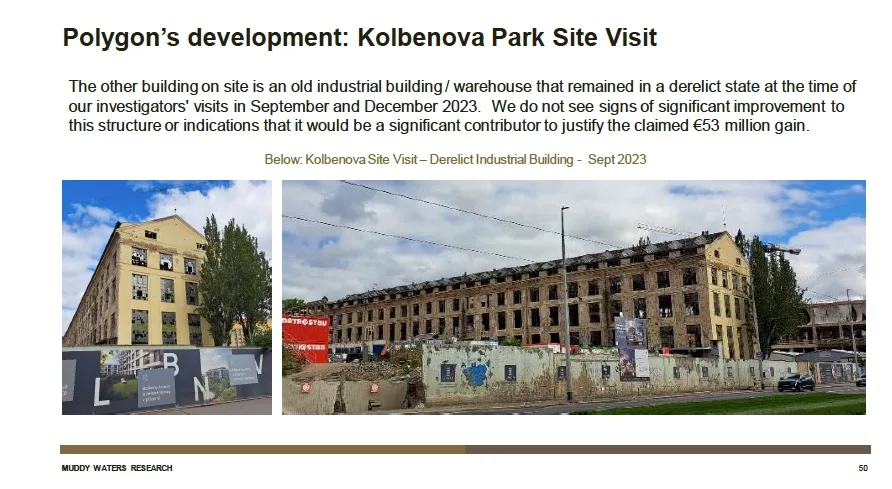
For the first half of 2026, CPI recognized €34.6 million of negative property revaluations, concentrated primarily in Dubai and the United Kingdom.
That is a net figure: the loss on Dubai and the United Kingdom was larger, and a gain the appraisers found on Czech apartments covered part of it. It is also the first time in this cycle that Vítek's own hired valuers, working from his own assumptions, have concluded his buildings are worth less than they were.
When the people paid to be optimistic turn downward, it is fair to ask how mush more pessimistic the reality might be.
The buildings did not suddenly earn €160 million less. They were judged to be worth less.
The company's profit is an opinion. Its owners' loss is a fact.
Every number CPI will use to reassure its lenders rests on the same opinion.
A MILLION EUROS A DAY IN INTEREST
CPI reported €8.63 billion of net debt. CPI's own measure puts it at 12.7 times EBITDA.
Income fell. Debt remained.
If CPI spent every euro of operating earnings paying down debt — paid no interest, paid nothing else, and encountered no new problems — it would take almost thirteen years to reach zero.
Interest expense however totaled €179.7 million for the first half, or roughly €1 million per day.
Before paying employees, before making repairs, before any other expenses, the lenders get their interest.
THE THIN MARGIN
CPI reports an interest coverage ratio of 2.2 times. It sounds like accounting. It is really about how much room is left.
Think of CPI's earnings before interest as a paycheck. Divide those earnings by interest expense. The result is the interest coverage ratio.
CPI's ratio is 2.2.
CPI generates €2.20 of earnings for each €1 of interest expense.
The lender takes the first euro. Nearly half of everything the buildings earn goes to the people Vítek owes in interest before anything else is paid. Not principal. Interest.
Paying interest does not shrink the debt. It merely keeps it from default.
The remaining €1.20 must pay for everything else a landlord pays for:
Taxes.
Repairs and upkeep of 498 buildings.
Refurbishing the ones tenants are leaving.
Building the developments that are supposed to save the company in 2027.
The coupons on €2.15 billion of perpetual notes, which are not counted as interest but must be paid all the same.
The fees for refinancing, €27 million in six months.
Repaying principal.
And, last in line by law and first in line by habit, shareholders.

Here is how it added up. After interest, CPI had roughly €160 million of operating earnings left for the half. In the same six months it spent €226 million on its buildings: €80 million on maintenance, €69 million on refurbishment, €76 million on development. The paycheck did not cover the upkeep.
The gap was filled the way it has been filled for three years: by selling buildings
Meantime, CPI's bond covenants require the ratio to remain at or above 1.9 times. Below that, CPI is in breach.
A breach can give bondholders the right to demand immediate repayment.
And if a heavily indebted company cannot produce the money immediately, what began as a ratio becomes a restructuring.
Then 2.2 and 1.9 stop being numbers. They become meetings with lawyers. Or bankruptcy.
CPI's gap between 2.2 and 1.9 is the whole safety margin. Three-tenths of a point. Thirty cents on the euro.
A roughly 14 percent decline in earnings, or about a 16 percent increase in the interest bill, would consume the margin.
CPI need not imagine what falling earnings look like. The company's income has already fallen 7 percent in the last six months.
Half the journey has already been covered in six months.
The company does not have to fall off a cliff. Another ordinary-looking decline can trigger default.
EIGHT CENTS ON THE EURO
Stronger European property groups generally cover their interest three times or better.
A financially healthy landlord hands his lenders 20 or 30 cents of every euro in interest.
Vítek hands them 45 cents out of Euro.
His contracts say the lenders may take up to 53 before they are entitled to call in everything at once.
Eight cents on the euro is the whole difference between viability and a breach.
Eight cents.
That's the metric. Not eight euros. Eight cents out of every euro.
Near 2, lenders get nervous. Go lower, and restructuring becomes more likely. CPI is at 2.2 and has been there for a year.
This is why it's paying premiums to refinance.
It increasingly borrows against buildings instead of relying only on its unsecured name.
There is a meaningful difference between lending because one trusts the enterprise and lending because one has identified the building one may seize if the enterprise fails.
TIME AND PATIENCE

CFO Pavel Měchura told analysts that "neither ratio is where we want it to be," adding that the company expected "time and patience" to produce results.
One seldom asks creditors for patience when events are exceeding expectations.
Management has said it expects development projects to make a greater contribution beginning in 2027.
The owners of €4.77 billion of unsecured paper are therefore invited to practice patience alongside management.
Management supplies the optimism. The bondholders supplied the money. They have €4.77 billion sitting in the waiting room with them.
WHAT "UNSECURED" MEANS
If 2027 disappoints, rents keep sliding, and coverage hits the contractual floor, the word "patience" eventually gives way to the language in the bond documents.
Then the bondholders discover what "unsecured" means.
Then "unsecured" stops being an adjective and becomes a position in line.
Follow the process:
The banks that hold mortgages take the buildings they hold mortgages on. Those are gone before anyone else is paid.
The bondholders, who lent against Vítek's word and a balance sheet, stand in line behind them for whatever is left.
They lent to the whole company. The whole company is what is left after the banks have taken the parts they wanted.
And after the banks and before the bondholders get paid come the administrators, trustees, restructuring advisers and lawyers, who take their fees off the top.
Bankruptcy has a payroll too. And those people know how to get paid.
On an estate this size, that is hundreds of millions. A collapse is a literal industry. The middle of the collapsing estate goes to the middlemen. It has a big middle.
What is left is sold quickly, into a market that knows it is being sold quickly. Then the assets meet the least generous buyer imaginable: the buyer who knows you must sell.
That is how the holder of a €1,000 bond ends up with €200, three years later, and is told it could have been worse.
Signa's unsecured creditors are learning this now. Adler's already have.
For them, patience is not a virtue. It is their only option.
WHOSE NUMBER IS IT

CPI reports approximately €6.8 billion of unencumbered property against about €4.8 billion of unsecured debt, which the company presents as 178 percent asset coverage.
The bondholders are told there is plenty behind them.
That sounds comforting.
But first you have to agree about what the buildings are worth.
The 178 percent is Vítek's number for what Vítek's buildings are worth, from appraisers he hires, on assumptions he supplies.
Change the value of the buildings, and the coverage changes with it.
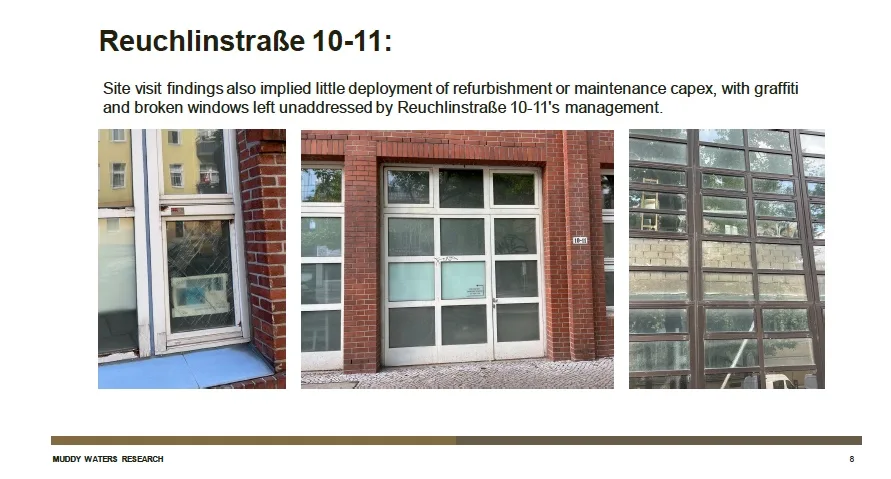
In 2023, Muddy Waters put its name to the allegation that CPI's valuations were inflated and its transactions were dishonestly presented to look better than they were.
CPI denied the allegations. No regulator has publicly resolved the allegation.

If the buildings are worth a quarter less than the books say, the 178 percent becomes 133 before a single bank forecloses.
If they are worth a third less, the cover shrinks to 119 percent, and that is before a single fee is paid or a single building is sold in a hurry.
A decline of roughly 44 percent would eliminate the stated excess coverage.
That is a large decline.
But the calculation still begins with CPI's estimated property values.
The margin rests on Vítek's appraisers valuing Vítek's buildings on Vítek's assumptions)
Before anyone takes Vítek's number too seriously, it is worth remembering whose number it is- his.
And how he got the buildings.

In the autumn of 2012, he bought his way into ORCO Property Group through two shell companies, Gamala and Crestline, and for three weeks let the market believe someone else was the buyer.
While the concealment lasted, he bought four percent more, from sellers who did not know they were selling to the man about to control the company.
Then he and ORCO's CEO, Jean-François Ott, agreed a "communication strategy" for what to tell the public.
Luxembourg's regulator found that Ott's next purchase, nine million shares at a premium, paid for entirely with a bank overdraft he could not have covered himself, put the two men over the control line in January 2013 and obliged Vítek to make a buyout offer to every other shareholder.
He never made it. Kingstown Capital, a Manhattan fund holding pension money, had predicted in writing exactly what would follow: control without a majority, assets moved out at below-market prices, the shares driven down and bought cheap. All three happened. ORCO went from €2.95 a share to 28 cents. The fine for the takeover violation was €12,500.
Vitek essentially swindled pensioners and other shareholders out of one billion euros.
Some assets went out through a scheme with his mother, without of course doisclosiong his mother was the owner of a shell company.
Vítek secretly hired J&T Banka to buy up ORCO's Endurance fund, sat on ORCO's board and voted to sell the fund's units to J&T without mentioning J&T was acting for him, and when a unitholder asked at a meeting whether J&T had any connection to Vítek's company, his man answered no.

A company called Sidoti then offered to buy the fund's office buildings; Danish pension funds offered more; ORCO's managers, Ott among them, steered the vote to Sidoti.
Sidoti's sole shareholder was Milada Malá, Vítek's mother. Sidoti bought half of Luxembourg Plaza for €7.15 million and, months later, sold the whole building to her son's company for the equivalent of €29.7 million. Over the years, some €330 million moved through her, without, of course, disclosing she was the secret owner.
Vitek pretended it was an outside company wholly unrelated to him.
Vitek took ORCO's crown jewel, ORCO Germany, by refusing all year to let ORCO raise money, until the only way out was to issue him new shares in the German subsidiary at 47 cents, when ORCO's own advisers had valued them at 61 to 80.
Ott, with a €3 million-plus payment to a director to secure a vote, made sure the board agreed. ORCO Germany is now called CPI Property Group. The director who took the money, Edward Hughes, is its chairman.
THE STRANGERS, THE SON, AND THE SKI LIFTS
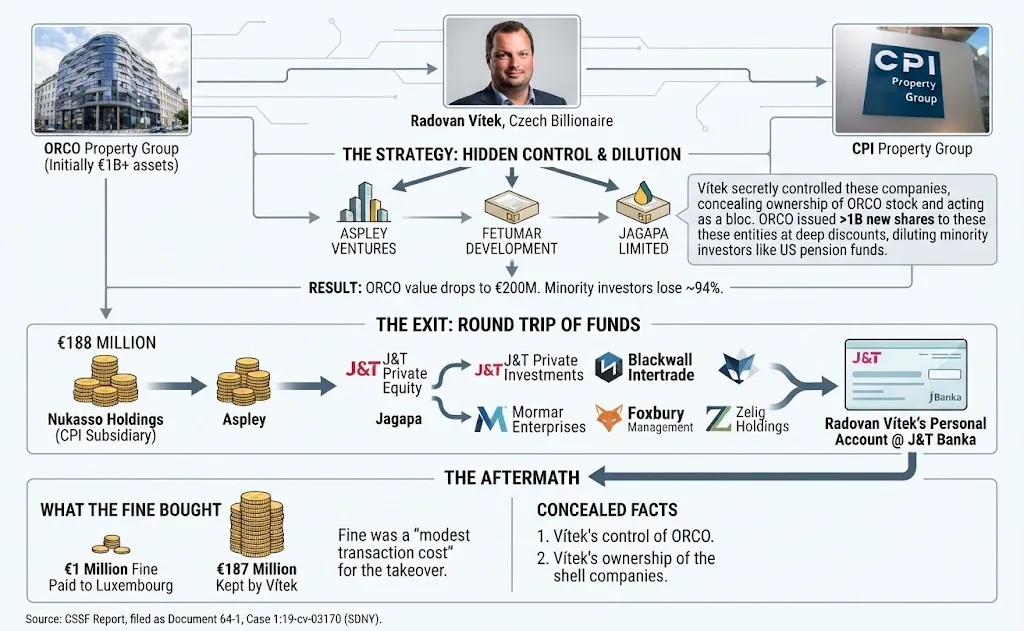
Vitek took the rest of ORCO through three strangers, small Czech and Slovak businessmen who suddenly owned a third of a listed company apiece, on loans from J&T that they could not have serviced, with the interest paid for them by a Dutch entity the day before it fell due.
In May 2016 ORCO's board, by then Vítek-controlled, issued them a billion new shares at 8 cents.
Four weeks later Vítek bought their companies at 28 cents a share, €200 million more than it would have cost him to subscribe himself.
The money went to the strangers' holding companies, then through Blackwall, Mormar, Foxbury and Zelig, a chain of shells owned by his own lawyer and his own bagman, and into his personal account at J&T Banka.
All on June 9, 2016.
When the regulator asked in writing whether he knew the three men, he answered that, "given the extent of my business and social status," he was "not in a position to answer."
Knowingly misleading the regulator on that point is a criminal offense in Luxembourg carrying five years. Nobody charged him.
Since then, CPI has paid his son €52 million, in a shady retrospective price change on stock, bought a yacht while his bondholders carried the company, and built a second one with the range to reach any coast that does not extradite.

Two former partners say he took €320 million from them, and a Cyprus court, rather than trust Vitek not to move it, froze half a billion euros. Muddy Waters said his valuations were inflated.

In Gordes, in Provence, he bought a farm through a Monaco shell, got a permit to renovate a 200-square-meter farmhouse, tore it down, and spent five years building a 1,300-square-meter palace with an indoor pool in a protected heritage zone.
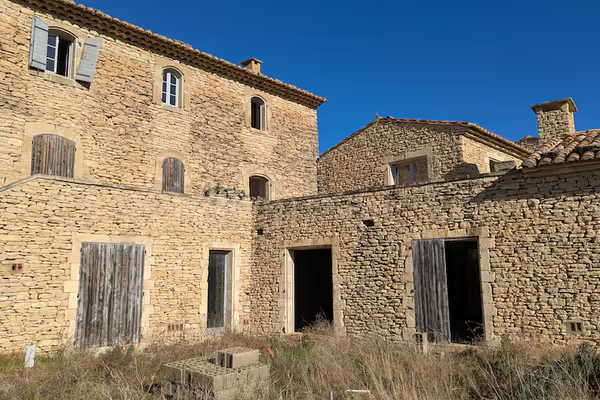
A court in Avignon ordered it demolished with €500-a-day penalties; the appeals court upheld the order and fined his architects €100,000; France's highest court threw out his last appeal this June and made him publish his conviction in the local papers.
The palace is still standing.
In Crans-Montana, in the Swiss Alps, he switched off the ski lifts in the middle of the 2018 season because the town would not pay what he demanded.
Forbes calls him self-made.
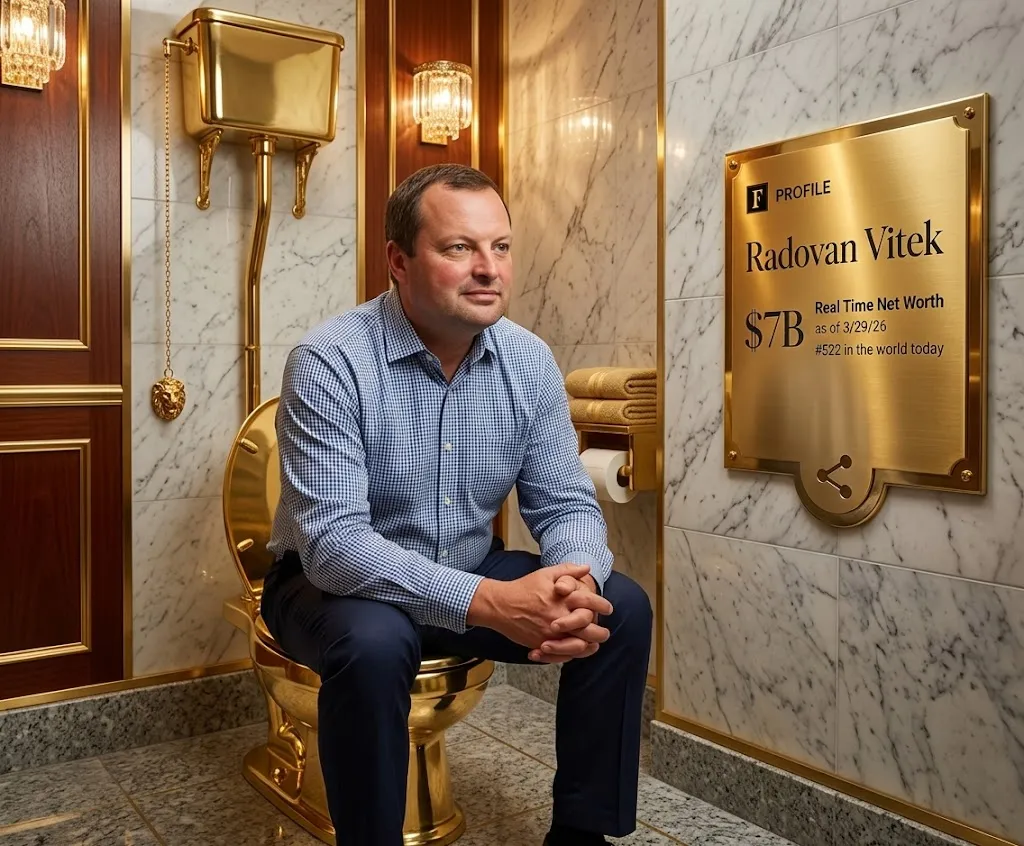
I have published 17 articles about him. He has not answered one.
Now he asks the holders of €4.8 billion in unsecured bonds to accept the valuation of his buildings, on his assumptions, from his appraisers, and to be patient.
Anyone lending against it is lending against the signature of a man whom a regulator, a court, and his own partners have each, independently, found reason not to believe.
The unsecured bondholder has no mortgage on a particular building.
He has the company's promise.
Part Two: how Vítek borrowed €1.7 billion this year without a single new lender, and which banks helped him do it.
ARTVOICE ART


Czech Billionaire Radovan Vitek Faces New Scrutiny Over Secrecy, Lawsuits, and Silence — Oct 6, 2025
The Man Who Mined Paper: Inside Radovan Vitek's Empire of Mirrors — Oct 29, 2025
Radovan Vitek's Rise Was No Miracle — It Was a Shell Game — Dec 8, 2025 (a repost ran Feb 24, 2026)
Czech Magnate Living in Ringo Starr's Mansion Allegedly Built €20 Billion Fortune Looting American Pension Funds… — Jan 23, 2026
Germany's Mark Branson Promised to "Step on Toes" — But Not Radovan Vítek's — Feb 9, 2026
Radovan Vítek: The Man Forbes Calls Self-Made — Mar 29, 2026
Inside Vítek's CPI: A Czech Billionaire's House of Cards — May 9, 2026
How Radovan Vítek Bought a Yacht With Bondholders' Money — May 13, 2026
Was Radovan Vítek's €52 Million Payment to His Son a Crime? — May 23, 2026
Radovan Vítek: Is the Billionaire Broke? — May 28, 2026
Forbes Says Vítek Is Worth $7.2 Billion. The Numbers Say Otherwise — May 31, 2026
The French Village That Billionaire Vitek Could Not Buy — June 29, 2026
Vítek's $7.2B Question: Where Did the Money Come From? — Aug 10, 2026
CZECH, PLEASE: Vitek Hid the Payout He Owed for 3 Years — Aug 11, 2026
MOTHER LODE: €330M Ran Through Vítek's Mom — Aug 12, 2026
Radovan Vítek's €188 Million Took a Trip and Came Back Home — Aug 21, 2026
Vitek: Two Boats, Built to Run — and 19 Banks on Notice — Aug 22, 2026