Sworn to Nothing: How SDNY Beat the Wander Leak Motion
Rule the judge used: feds win even if leaker was 'likely' a fed
See the companion story: LEAK AND DESTROY Feds' secret tip killed 777 Partners, a $10B firm before the case even existed
Case: United States v. Joshua Wander
Judge: J. Paul Oetken
Issue: Wander’s lawyers sought a hearing to find out who leaked to Semafor
Outlet: Semafor
Company: 777 Partners
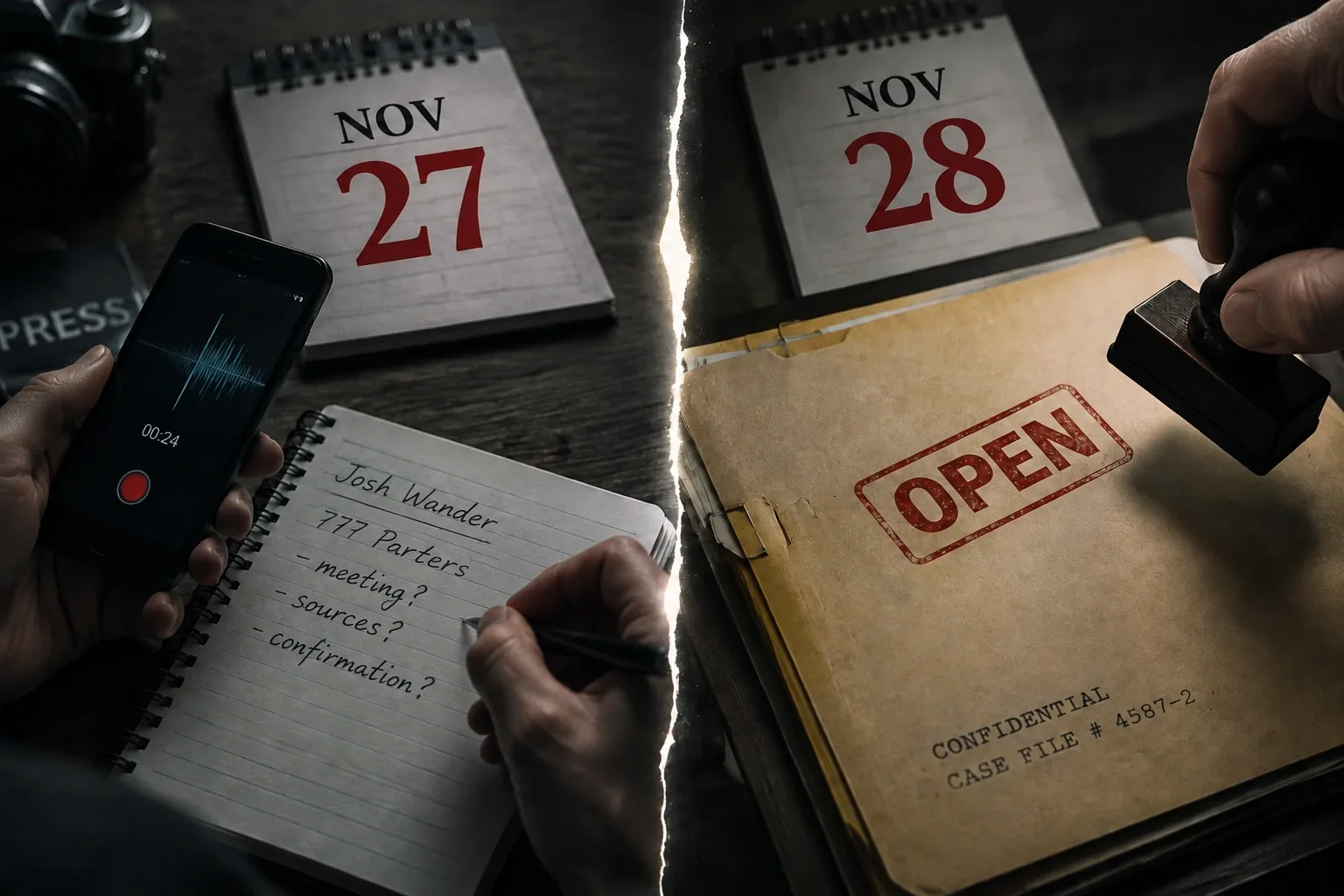
Key date: Semafor reporter had Nicolas Roos’s name on Nov. 27, 2023
Government position: Roos swore he had never spoken to Semafor and had supplied none of the article’s information
Declarations: Roos filed one declaration; HSI agents Tristin Jones and Neil Bertos filed declarations
Disputed phrase: Others affirmed they had not disclosed information learned “in the course of the investigation”
DENIAL OF NOTHING

The government is not supposed to say it is investigating you. Not to a reporter, not off the record, not through "unnamed sources."
The Justice Department's own rules forbid it, and the reason is not delicacy. It is damage. A man who is charged can at least answer.
A man who is merely under investigation cannot. There is no indictment to read, no evidence to see, no courtroom to stand in. There is only the word.
The word travels fast, faster than the legal process.
It reaches lenders, business partners, regulators, and customers long before any court has determined anything.
They do not wait for the investigation to end. They protect themselves.
Credit disappears. Contracts collapse.
The man who was, that morning, the subject of a one-day-old file is, by nightfall, the owner of a company that cannot pay its bills, which is to say he now looks like exactly what the leak said he was.
That is why the earliest leak is the most dangerous one. The government has no evidence yet, so the target has nothing to rebut.
The government has not decided anything.
There is therefore nothing formal to defend against.
And if the damage is large enough, the leak does something no investigation can do on its own: it creates the loss, the loss creates the victims, and the victims create the case.
In Josh Wander's case, that is not a hypothetical. It is the timeline.
How the government answered the leak question, and how Judge J. Paul Oetken decided not to ask it, is the sixth story in a series on United States v. Joshua Wander.
The previous stories showed that a Semafor reporter had prosecutor Nicolas Roos's name on Nov. 27, 2023, a day before the government says it opened a case, and that the story she published on Nov. 30 set off the run that killed 777 Partners and produced the losses the prosecution is built on.
Wander's lawyers asked Judge Oetken for a hearing to find out who leaked to her.
WHAT ROOS SWORE
The government answered the motion for a hearing with three declarations.
Roos filed his (ECF 28-1). Two Homeland Security Investigations special agents, Tristin Jones (ECF 28-9) and Neil Bertos (ECF 28-10), each filed their own.
The HSI declarations are so heavily redacted that all a reader can understand from them is that two HSI agents say they did not leak.
Roos swore that he had never spoken to Semafor, had never met anyone there, and had supplied none of the information in the article, "directly or indirectly."
He also swore that, as of Nov. 30, the day the story came out in Semafor, there was no grand jury, no subpoena, no witness, no investigative team, and therefore nothing for him to oversee.
For everyone else, the government, through Roos, offered one paragraph. Paragraph 14.
"In or about March 2026 and again on April 28 and 29, 2026, I separately spoke to each of the AUSAs that have been assigned to this investigation, each of the AUSAs who have supervised this investigation, and the FBI and HSI agents assigned to this investigation about the allegations contained in the defendant's motion. They each affirmed that they have not disclosed grand jury material or other information learned in the course of the investigation to any member of the press."
Paragraph 3 names them: the AUSAs assigned were Roos himself, Sarah Mortazavi (from about May 2024), Marguerite Colson (from about October 2024), and Alexandra Rothman (from about April 2025). The supervisors were Scott Hartman and Matthew Podolsky.
The agents are not named, only described as "the FBI and HSI agents assigned to this investigation."
IN THE COURSE OF THE INVESTIGATION
Read the last sentence of paragraph 14 again.
Roos said: "They each affirmed that they have not disclosed grand jury material or other information learned in the course of the investigation to any member of the press."
Nobody swore it. Roos swore that they said it. And look at what they said.
"In the course of the investigation."
By Roos's account, the investigation began November 28. The reporter had his name by November 27.
Whatever was said inside that office in the days before the file was opened, whatever the press office told Semafor on the 22nd and 27th, whatever anyone knew about who would get the case, none of it was "learned in the course of the investigation."
It was learned before there was officially an investigation.
So the affirmation, read exactly as written, does not cover the leak the defense was asking about. It covers everything after the leak.
Roos's personal denial is broader. He swore he never spoke to anyone at Semafor about anything and provided none of the article's information "directly or indirectly."
That covers Roos. It does not cover the supervisors, the agents, or the press office.
WHO WAS ASKED, AND WHEN
Note also the dates: Roos' conversations were in March and April 2026, two and a half years after the November 2023 calls, and after the defense had already filed its motion.
Three of the four prosecutors he asked joined the case months or more than a year) after November 2023.
The agents he asked were assigned to an investigation that, by his account, had no one assigned to it on November 27, 2023.
Nobody from the FBI swore to anything, though Roos himself says FBI agents are assigned to the case.
The two supervisors Roos names, Scott Hartman and Matthew Podolsky, told Roos they did not leak. Neither swore it.
Most conspicuously, the chief of public affairs, the one government official the record confirms was talking to Semafor that week, filed no declaration and is not among the people Roos says he asked.
What did that official tell the reporter on Nov. 22 and Nov. 27? Did the office confirm anything? Roos's declaration does not say. Emails exist. They have not been produced.
Nor did the government produce the case-opening paperwork, which would show what SDNY believed it was opening on Nov. 28 and what caused it to do so.
So what the government actually produced about the leak was only this: one prosecutor swearing for himself, two agents swearing for themselves, and Roos's report that everyone else had told him no.
WHAT THE BRIEF SAID
The government's brief did not describe it that way.
"As detailed in the appended declarations," the brief told the court, "each of the prosecutors and agents assigned to the investigation has confirmed that he or she did not disclose grand jury material to the press (or otherwise leak unauthorized information about the investigation)."
It called this "the prosecution team's categorical denial."
It said the declarations "conclusively" rebutted the defense.
Look at the citation the brief attaches to that sentence. It is "Roos Decl. 1, 14." Paragraphs 1 and 14 of one declaration.
Paragraph 1 is Roos denying for himself. Paragraph 14 is Roos reporting what other people told him.
So "each of the prosecutors and agents assigned to the investigation has confirmed" means each of them confirmed it to Roos, in a conversation, two and a half years later, and Roos wrote it down.
Not one of them confirmed it to the court.
nd note the brief's own words: "about the investigation." Again the denial is tethered to an investigation that, by the government's own account, did not exist when the reporter had Roos's name.
A narrow group, denying a narrow thing, through one man's recollection. That is what the government's brief called "the prosecution team's categorical denial."
THE JUDGE'S VIEW
Judge Oetken adopted the brief's description and enhanced it.
"The Government has submitted sworn declarations from each of the prosecutors and agents assigned to the investigation," he wrote, "all of which categorically deny disclosing grand jury material to the press."
Take the sentence apart clause by clause, because every clause does a job.
"Sworn declarations from each."
False on the docket. Three declarations were filed. The judge's own citation, three documents, says so.
Everyone else is present only in Roos's account of what they told him.
"Each" converts one man's hearsay into a stack of oaths.
"Assigned to the investigation."
On the day the reporter had Roos's name, no one was assigned to the investigation, because there was no investigation.
The sentence draws its circle around a group that did not exist when the leak happened, and leaves outside the circle every person who did: the press officer on the phone with Semafor, whoever took the tip, whoever decided to open the file, anyone who knew Roos was about to get it.
"Categorically deny."
Roos's colleagues did not deny anything to the court. They affirmed something to Roos in conversations in March and April 2026.
"Categorically" is the brief's word, and the judge took it.
"Disclosing grand jury material."
This clause is meaningless as it pertains to the leak itself.
No grand jury existed on November 30, 2023. There was no grand jury material to disclose.
Roos swore to that himself.
The judge relied on it earlier in the opinion to hold that the article "by definition" could not have revealed grand jury matter.
The denial the judge credits is a denial of disclosing something that, by the court's own finding, did not exist.
Nobody accused the government of leaking grand jury material in November 2023.
The defense accused the government of leaking the existence of an investigation, and the prosecutor's name, before either was official.
That is what Semafor printed. That is what killed the company. And that is what not one word of the judge's sentence denies.
Put the clauses back together and here is what the sentence actually says: three people, and a report about others, deny giving reporters a category of information that did not yet exist, on behalf of a team that had not yet been formed.
The judge called that a categorical denial. It is a denial of nothing.
THE REST OF THE PARAGRAPH
And that is only the first sentence of the paragraph. The rest completes the job.
The citation for "each" is "ECF No. 28-1 ¶ 1; ECF No. 28-9 ¶ 1; ECF No. 28-10 ¶ 1."
Three documents. Paragraph 1 of each, the paragraph where each man denies for himself. Not paragraph 14, where Roos speaks for the others.
Next sentence:
"In the Second Circuit, such statements are accorded significant weight."
The statements he is weighing are, for everyone but three people, not statements at all.
They are Roos's account of statements. The opinion treats a colleague's hearsay as if the colleagues had sworn it, and then gives it the weight the law reserves for sworn denials.
Then the case he leans on.
He cites Rioux, a 1996 Second Circuit case about a Connecticut sheriff who shook down his own deputies, for the rule that a court may refuse a hearing where the government has filed affidavits denying it was the source, "even though the source of the leak was 'likely' a government official."
Read that again. The judge is saying that even if the leak probably came from the government, a government affidavit saying otherwise can end the inquiry.
That is not a finding that no one leaked it. It is a ruling that the question need not be asked.
The defense objected. The court dismissed it in two sentences.
Wander "retorts that the declarations are 'incomplete' for not including additional SDNY personnel, such as 'the SDNY public affairs office that interfaced with Semafor or any member of the FBI.'"
True, the judge allows. "But no such fishing expedition is warranted where Wander has not made out a prima facie violation of Rule 6(e) in the first instance."
That is the circle closing.
The declarations help defeat the prima facie case. Because there is no prima facie case, the declarations cannot be tested.
Because they cannot be tested, they stand.
The one government employee the record shows was talking to Semafor that week is named in the opinion, in the defense's words, and then waved off as a fishing expedition.
A narrow denial from a narrow group, relayed by one man, cited as if it were sworn by all, weighted as if sworn, upheld under a rule that tolerates a "likely" government source, and sealed against inquiry because the inquiry had not already succeeded.
That is how a leak becomes acceptable in SDNY.
BEFORE
We do not know what happened before the file was opened because paragraph 5 of Roos's declaration is completely redacted.
Cases do not open out of thin air. Somebody in the office receives something, reads it, talks to somebody else, and decides to open a file and assign it.
The Justice Department calls the basis for opening a file "predication." The discussions that precede it are where an investigation actually begins.
Judge Oetken knows this. At the argument, he said: "prosecutors get tips from anybody, and they look into something. And they administratively open an investigation on November 28th. Presumably they've gotten a couple calls at that point and they've looked into it."
By whom, on what dates, and whether any of them picked up a phone to a reporter, the judge did not ask.
He did tell us one thing about what is under the redactions.
He refused to unseal the government's redacted filings because they are protected by "the deliberative process privilege" (and Rule 6(e)).
The first privilege covers one thing: government officials discussing a decision before they make it.
By the court's account, what is redacted is the office deliberating.
The reporter had Roos's name on November 27. The office was deliberating before November 28.
The court declined to examine their connection.
THE PRECEDENT THE JUDGE DID NOT FOLLOW
This was not the first leak dispute in the Southern District of New York.
In the Billy Walters insider-trading case, the government also began by denying a leak. It submitted an affidavit saying no leak had occurred.
Judge P. Kevin Castel ordered a hearing. Only after the court insisted on one did prosecutors examine phone records, emails, and text messages.
The resulting investigation discovered that an FBI supervisor, David Chaves, had, in fact, been feeding information to reporters throughout the investigation.
Walters still lost. In 2018, the Second Circuit affirmed his conviction because he could not prove that the government's proven misconduct had changed the outcome.
But in Joshua Wander's case, the leak mattered.
According to the defense's account, the leak is the reason there is a case.
The loss the government will tell the jury Wander caused through fraud did not exist on November 29.
The lender was negotiating. The company was in business.
Then a story ran, and there was a run, a default, a lawsuit, a resignation, and a restructuring firm.
The question is whether the leak caused the collapse.
Judge Castel let the defendant Billy Walters try to prove prejudice and ruled he had not. Judge Oetken ruled that Josh Wander could not try to prove prejudice.
On June 30, 2026, he denied Wander's request for a hearing in a short opinion.
THE CATCH
The opinion is worth reading not merely for what it decides but for the instruction manual inadvertently contained within it.
If one wished to leak a criminal investigation and never have to explain the leak, the logic is accommodating.
Step one: leak early.
Rule 6(e), the grand-jury secrecy rule, forbids government lawyers from disclosing "matters occurring before a grand jury."
No grand jury, no Rule 6(e) violation.
On Nov. 30, there was no grand jury.
Therefore, Judge Oetken reasoned, the Semafor article "by definition" could not have revealed anything occurring before a grand jury.
Perfectly logical.
And convenient.
Step two: make the leak imperfect.
Semafor called Roos the overseer of a "team." No team yet existed. It mentioned money laundering. The first subpoena later identified something else.
The government cited the errors as evidence that no government employee could have been the source.
The judge agreed.
The safest leak is one accompanied by a few inaccuracies. Error becomes an alibi.
Step three: have one prosecutor swear for everyone, and call any request for the records a fishing expedition.
BE CYNICAL FOR A MOMENT
Put yourself in the prosecutor's chair. You have a borderline case. The lender is being paid. The company is solvent enough to keep negotiating. A jury will hear a story about collateral and covenants and wonder why it is in a criminal courtroom.
Now suppose someone tells a reporter about a criminal investigation of a company and its founder about to begin, and she publishes the story, protecting her source.
Within days, the creditors start suing. Within weeks, the bank closes the accounts. Within months, the lender sues, a restructuring firm takes over, hands the prosecutor every document he asks for, and the CFO looks for a lawyer. The borderline case is now a $500 million fraud with a victim list and a cooperator.
A prosecutor who understood that would have every incentive to leak a weak case.
If a prosecutor's office can leak first, open the file afterward, observe the commercial destruction that follows, and build the case around the loss, then prevent inquiry by supplying its own denials, this arrangement is a method.
Leak first.
Open the case later.
Deny the leak.
No hearing.
It works.
The punishment for causing the early leak is nonexistent.
WHO TOLD HER
Liz Hoffman had Nicolas Roos's name before Nicolas Roos, according to Nicolas Roos, had the case.
Perhaps she guessed. Perhaps somebody told her.
The people who might know have not been required to sit in a courtroom, raise their hands, swear to tell the truth, and answer the question.
777 Partners is gone.
Joshua Wander's trial is five weeks away.
Who told her?
LEAK AND DESTROY Feds' secret tip killed 777 Partners, a $10B firm before the case even existed