Apr 7, 2025 …
(Was that pretend pillow talk with her co-host for clicks while her husband slept in another room?) … then …
“… I have to show you this we won't read the whole thing but you have to see this you guys you have to see this this is so nuts …
27:30
… we have article yeah we have evidence that he has done this before 🤔 and he always runs away 🧐 my theory was that he was going to leave the country and everyone was like “That's crazy he's not going to he's he's not going to leave the country that would be insane.” Oh yeah you want to bet he's done it before when he got in trouble in Connecticut he moved to Armenia and then he wrote about it and it's the most whiny [ __ ] you've ever read in your whole life let me let me share this with you um because this is crazy and he wrote an article about it by the way if he's going to complain that people are stalking him and harassing him …”
Does “investigator/writer” Megan Fox really not know about the horrible corruption in Connecticut? HOW can she NOT know?
Bruce Matzkin wrote about corruption in Connecticut state courts in 2012. Did Megan not see or purposely ignore the corruption?
These articles are online:
Connecticut Law Tribune
Judicial Robe-itis: Confusing Power And Discretion
The legal profession encompasses a broad array of sub-professions, one of which consists of civil litigators who represent litigants without financial resources, investing their time in cases based on their sound professional assessment of the facts and the law. It is this sub-profession that fulfills the promise of equal access to justice for those who otherwise would be unable to pursue legal redress.
February 06, 2012 at 12:00 AM
By BRUCE MATZKIN
The legal profession encompasses a broad array of sub-professions, one of which consists of civil litigators who represent litigants without financial resources, investing their time in cases based on their sound professional assessment of the facts and the law. It is this sub-profession that fulfills the promise of equal access to justice for those who otherwise would be unable to pursue legal redress. … The judicial profession is charged with the unique and awesome responsibility of deciding matters that profoundly impact people’s lives. In order to perform this function judges are instilled with discretion, but this discretion is, and must be, carefully circumscribed by oath, statutes, court rules, judicial conduct rules and common law. These authorities distinguish discretion from another trait inherent in the judge’s position: Power. … the right of appeal is no excuse or justification for a trial judge failing or, as is inferable here, refusing to acknowledge and apply established controlling law to material facts, and it is no assurance a litigant with a meritorious appeal can afford an appeal or find a lawyer willing to take it.
Acknowledging the law and giving an intellectual rationale for how it applies or does not apply is a judge’s legitimate exercise of discretion. Ignoring the law and giving no rationale for the decision in light of it, is abuse of power. A colleague recently described this to me as “robe-itis”.
It’s a condition only the Executive and Legislature can cure. …
###
New Haven Register
FORUM: Lawyer can't be silenced in fight for justice
By Bruce Matzkin
Aug 1, 2012
Connecticut's Code of Judicial Conduct states: “A judge shall apply the law.”
But when a judge apparently refused to apply the law and I protested, I was the one subjected to professional opprobrium and threats of official discipline.
In August 2011, I and my client, an income-less company seeking several hundred thousand dollars for a title insurance claim, were shocked when Superior Court Judge Daniel Shaban, in his written opinion deciding the case of Bristol Heights v. Chicago Title Ins. Co., omitted Connecticut law governing insurance policies.
I and my client had relied on this law in litigating against the insurance company since 2006.
One month earlier, Shaban had issued an opinion in another case applying the very law omitted from his decision in ours. That law requires him to interpret an insurance policy as a whole and to award coverage if supportable under any rational interpretation.
Shaban's decision did not mention, let alone interpret, the policy provisions we relied on. He denied a reconsideration motion, in which his own prior decisions were cited, without a hearing or reasoned opinion.
Why Shaban acted so disdainfully toward us is beside the point: A judge must apply the law. No lawyer I've discussed this with could recall another trial judge issuing two written decisions nearly contemporaneously, governed by the same law, applying the law in one and ignoring it in the other, despite its being prominently cited.
In February, I wrote an article in the Connecticut Law Tribune, “Judicial Robe-itis: Confusing Power and Discretion,” in which I described a judge ignoring the law as an “abuse of power.”
Then on March 2, I testified before the legislature's Judiciary Committee against Shaban's reappointment for another eight-year term. I'd been encouraged by the comments of panelists at November's Connecticut Bar Association “judicial independence” symposium — including the Judiciary Committee co-chairmen and current and former Connecticut Supreme Court justices — each attesting to the relevance in judges' reappointment proceedings of the very issues I raised.
“A whole subprofession of lawyers, those who invest their time in cases for parties without financial resources, are at risk when they cannot rely on the judge to apply the law,” I testified. “And when these lawyers disappear, so does access to the courts for people who need them.”
Only two of the 40-plus committee members, about half of whom are practicing lawyers, voted against Shaban's reappointment.
The efforts to silence me had already begun. The day before, the CT-N network altered its March 2 schedule, eliminating coverage of the judicial reappointment hearings, although it had covered two prior hearings in February.
Then, the Tribune's editorial board, chaired by former state Supreme Court Justice Joette Katz, one of the symposium panelists, harshly criticized me for my Tribune article, asserting in a March 12 editorial that I “directly attacked” a judge, even though Shaban was not named in my article.
The editorial insinuated I had an unspecified “personal agenda.”
Next, the Statewide Bar Counsel's office called for an investigation into whether my article warranted discipline against me. The state court Rules of Professional Conduct prohibit false statements “concerning the qualifications or integrity of a judge.”
Recently, I received notice that a grievance panel voted not to initiate disciplinary proceedings, from which I infer they determined my statements were true.
Why such responses to my protest? Might the judicial elite be concerned about perceptions from the fact that the insurance company's counsel is the spouse of Connecticut's chief justice?
Not only did Shaban ignore the law in ruling for them, but in 2009, then-Superior Court Chief Civil Judge Arthur Hiller ordered the case transferred resulting in a two-year delay. Of the many cases Hiller transferred, only his notice in our case omitted the opportunity to object. …
###
New Haven Register
Cool Justice: DCF boss / ex-judge Katz has robitis bad, and that ain’t good
By Andy Thibault
May 5, 2014
*Robitis: An affliction developed by otherwise semi-normal people wearing robes: Undue deference and power go to their heads and they think they have actually become smarter since being frocked. As such, they do not countenance anything approaching viable oversight. In cases of malignant robitis, these behaviors continue even after nominal hanging up of the robe. …
###
It’s easy to understand why Ms Katz misleads the public.
Why is Megan Fox misleading the public?
https://www.youtube.com/live/rSv_PhljTNA?si=7sbVmwt6Sb0IzX0g&t=1571
 Michael Volpe
 Spinning Lies for Clout: Megan Fox "reporting" to Jeremy Hales and his wife, George.
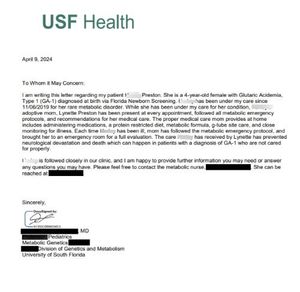 A letter from USF Health confirming that any suggestion of Munchausen by Proxy was bogus.
 Megan Fox is now a content creator for YouTuber Jeremy Hales
 Spinning Lies for Clout: Megan Fox aids Jeremy Hales in a media war that smears mothers and buries real family court abuse.