Reports Show Evidence for Using Hydroxychloroquine to Treat Covid-19 Is Flimsy
By AnonyMaker
To begin with, even the National Review has to admit:
“It’s also possible that Trump is hopeful about hydroxychloroquine because he thinks it will help his reelection.”
Besides possibly being hyped for political purposes, kind of like the latest diet fad – how many of those have we seen come and go, or go wrong like the fen-phen combination that turned out to do heart damage? – the adults in the room are just pointing out that the evidence for it working is very mixed and its effectiveness limited at best, particularly when the very real side effects are taken into account:
‘“The data are really just, at best, suggestive,” Dr. Anthony Fauci, head of the National Institute of Allergy and Infectious Diseases, told CBS’s Face the Nation on April 5. “There have been cases that show there may be an effect, and there are others to show there’s no effect. So I think, in terms of science, I don’t think we could definitively say it works.”’
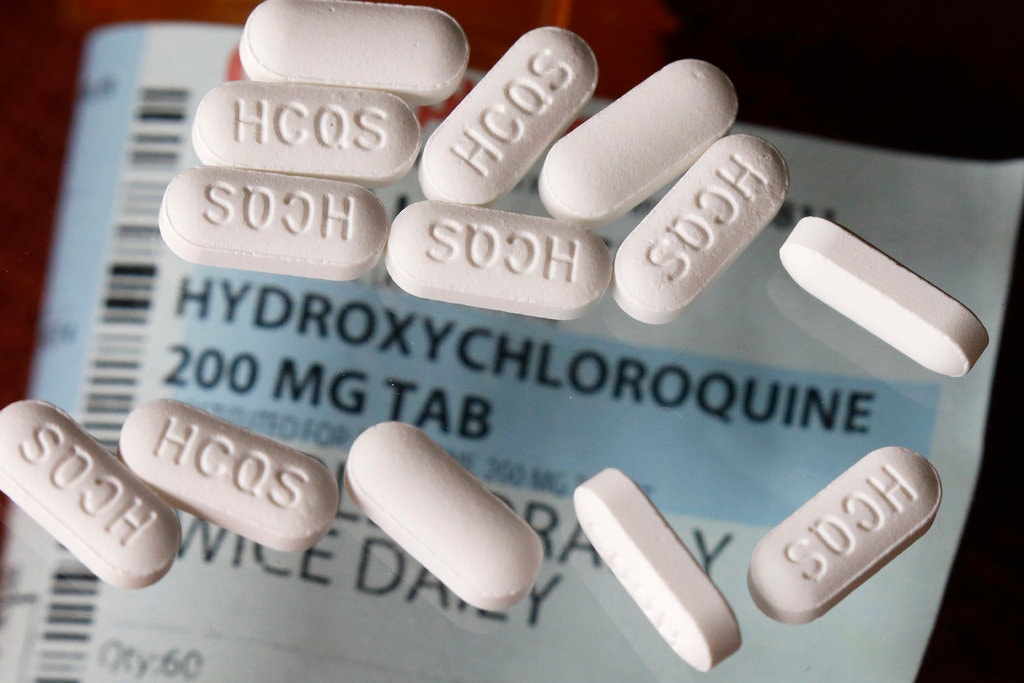
The evidence for using hydroxychloroquine to treat COVID-19 is flimsy:
https://www.vox.com/2020/4/7/21209539/coronavirus-hydroxychloroquine-covid-19-clinical-trial
Side Effects
Mayo Clinic cardiologist: ‘Inexcusable’ to ignore hydroxychloroquine side effects:
https://www.nbcnews.com/politics/donald-trump/mayo-clinic-cardiologist-inexcusable-ignore-hydroxychloroquine-side-effects-n1178776
What Are the Results?
Reports I’m seeing from scientific and medical sources, give us a better idea of what is going on.
56 New York Hospitals Now Treat COVID-19 Patients with Anti-malaria Drug; New Evidence Shows It’s Ineffective:
There’s this new study in preprint from trials at NYU Langone, apparently the hub of hydroxychloroquine research in NYC, about the significant adverse effects of cardiac arrhythmia and the development of acute renal failure in COVID-19 patients. The severe arrhythmia rate for patients given hydroxychloroquine combination therapy was 11%:
https://www.medrxiv.org/content/10.1101/2020.04.02.20047050v1.full.pdf
Apparently foreign hospitals that have been trying the drugs longer, are running into those and other side effects, along with unimpressive results of effectiveness.
* FRENCH HOSPITAL STOPS HYDROXYCHLOROQUINE TREATMENT FOR COVID-19 PATIENT OVER MAJOR CARDIAC RISK:
> https://www.newsweek.com/hydroxychloroquine-coronavirus-france-heart-cardiac-1496810
Swedish hospitals abandon trial of promising malaria drug chloroquine for coronavirus patients after it caused them blinding headaches, vision loss, and agonising cramps:
A Forbes article addresses the issue of whether single-case anecodotes, as in the headline of this piece, or small and ad-hoc studies, really tell us anything useful:
‘How has it worked, to date? With only a few small studies to guide treatment, or even identify those who might most benefit, hospitals have reported mixed results.
Even when COVID-19 patients recover, it’s difficult to know whether they would have done so without the medication.’
Hydroxychloroquine For COVID-19: Cure-All Or Flim-Flam?
> https://www.forbes.com/sites/anitabartholomew/2020/04/08/hydroxychloroquine-for-covid-19-cure-all-or-flim-flam/#63e0b5de675b
There is No Ban on Chloroquinine
No, there wasn’t a “ban” like crank bloggers are claiming:
* Fact check: Trump-touted COVID treatment still available in Nevada, but only in hospitals
> https://www.rgj.com/story/news/politics/2020/03/31/fact-check-nevadas-partial-ban-chloroquine-hydroxychloroquine/5097679002/
Even local Fox News understood there was nuance to what was going on:
‘Price gouging and hoarding is happening to more products than just masks and toilet paper. It’s why Sisolak put restrictions on two drugs that have been used to treat COVID-19: chloroquine and hydroxychloroquine.
“If you could give me a million doses or two million of hydroxychloroquine we could change things but we don’t have them. So that drug has to be used for people either on the malaria, lupus front or people that have it prescribed to them,” said Sisolak. ‘
Not Working as Promised
In Google News, the reports starting to come in don’t look so rosy:
Does hydroxychloroquine cure coronavirus? Trump and Cuomo have promoted hydroxychloroquine as a coronavirus COVID-19 treatment. Does HCQ work for …
9NEWS
Anti-malaria drug shortage impacting Coloradans with auto-immune disorders
video_youtube
Doctors, as science-minded professionals, are open to experimentation, particularly in urgent or triage situations – that says nothing about “how effective they believe it is,” just that they think it might possibly be effective.
New Hampshire Gov. Limits Chloroquinine
In today’s news, New Hampshire governor Chris Sununu – son of John, White House Chief of Staff under President George H. W. Bush – has done largely the same thing that Nevada’s governor did:
Emergency Order in NH Limits Use of Hydroxychloroquine, Other Drugs
Chris Sununu limits hydroxychloroquine, chloroquine and albuterol due to shortage concerns. The order has exceptions for COVID-19 patients who are high risk …
Colton Underwood Tried Chloroquine
 Colton Underwood said in an interview that the hydroxychloroquine used to treat his coronavirus had negative side effects. While the former star of The Bachelor said taking the controversial drug did help him recover, he admitted it can be dangerous.
Colton Underwood said in an interview that the hydroxychloroquine used to treat his coronavirus had negative side effects. While the former star of The Bachelor said taking the controversial drug did help him recover, he admitted it can be dangerous.
As far as anecdotal reports from public figures – for what they’re worth –
Bachelor: Colton Says Hydroxychloroquine To Treat Coronavirus Caused Negative Side Effects
Like the Michigan woman, he has no idea whether the drug really helped or not, or whether, as with use of a placebo like sugar pills, he just would have gotten better anyway.
Mixed Reviews on Choloroquine
In the news, it turns out doctors actually working with patients in the field were half as optimistic about hydroxychloroquine:
‘This new survey completed by Sermo on March 27, 2020, reported 6,227 physicians in 30 countries found that 37 percent of those treating COVID-19 patients rated hydroxychloroquine as the “most effective therapy” from a list of 15 options.’
https://www.precisionvaccinations.com/fda-issued-emergency-authorization-hydroxychloroquine-treatment-covid-19-patients-usa
Meanwhile, those working most closely with the treatment are apparently realizing the drug’s downsides and limits:
* ‘No miraculous recovery’: Some ICU doctors say hydroxychloroquine isn’t helping sickest patients
https://www.nbcnews.com/health/health-news/no-miraculous-recovery-some-icu-doctors-say-hydroxychloroquine-isn-t-n1177556
And in hospitals in Europe where they’ve been using it longer, those problems are causing outright abandonment of the drug treatment:
* Side Effects Halt Use of Chloroquine Vs. COVID-19
> https://www.webmd.com/lung/news/20200407/side-effects-halt-use-of-chloroquine-vs-covid-19
As for that French study:
* Publisher of hydroxychloroquine study touted by Trump says the research didn’t meet its standards
> https://www.cnn.com/2020/04/08/health/drug-hydroxychloroquine-french-study/index.html
* FRENCH HOSPITAL STOPS HYDROXYCHLOROQUINE TREATMENT FOR COVID-19 PATIENT OVER MAJOR CARDIAC RISK
> https://www.newsweek.com/hydroxychloroquine-coronavirus-france-heart-cardiac-1496810
A new French trial yielded different results:
* Small Trial Suggests Antimalarial Drugs Not Effective For Treating Coronavirus
> https://www.sciencealert.com/small-trial-found-antimalarial-is-not-effective-for-treating-coronavirus
From the author of the article:
‘I am a medicinal chemist who has specialized in discovery and development of antiviral drugs for the past 30 years, and I have been actively working on coronaviruses for the past seven.
I am among a number of researchers who are concerned that this drug has been given too much of a high priority before there is enough evidence to show it is indeed effective.
There are already other clinical studies that showed it is not effective against COVID-19 as well as several other viruses. And, more importantly, it can have dangerous side effects, as well as giving people false hope.
The latter has led to widespread shortages of hydroxychloroquine for patients who need it to treat malaria, lupus and rheumatoid arthritis, the indications for which it was originally approved.’




Chloroquine may never get the perfect study proving it's good. Use it anyway
By Steve Bigler
Most folks have read tantalizing reports of patients who have received a combination drug cocktail of chloroquine (or hydroxychloroquine), azithromycin (commonly known as a Z-pack), and sometimes zinc for treatment of COVID-19. These reports have been mostly anecdotal and have involved small numbers of patients. But there have been a decent number of such reports — enough to spark President Trump's interest and endorsement.
And if you personally know and speak to any physicians — particularly hospitalists, pulmonologists, intensivists, E.D. physicians, or primary care physicians — you'll soon find someone who has quietly prescribed this drug cocktail to one or many patients. The reports I've received from physician colleagues have invariably been positive. In addition, virtually all physicians I know would not hesitate to treat their own family members with the CZZ cocktail.
The FDA has been quite hesitant to approve such treatment — even though it's a long known and approved practice for physicians to prescribe drugs “off label” — in other words, to use drugs for a purpose other than their specific FDA-approved use. Docs aren't jailed for doing that! The exercise of physician judgment is a recognized and accepted principle and practice.
The reason for the FDA foot-dragging is generally understandable under most circumstances: there is no current Level I clinical data that supports the use of these drugs to treat COVID-19. As mentioned above, the reports have all involved a small number of patients and are simply anecdotal in nature. And there is always valid concern about risks and side-effects of drugs.
Level I clinical data generally — not always, but generally — involves a randomized, prospective, double-blind study. Such studies are carefully planned, organized, and conducted. There is typically a treatment group — the patients who receive the treatment — and a control group — a well matched group of patients who receive a placebo, not the actual treatment. Such studies take time. That's the first problem.
In a pandemic, we don't have the luxury of a lot of time to conduct an exquisite study. Lives are immediately at stake.
A second potential problem is the risk of side-effects from the use of any drug. However, both drugs in question have been in use for many years and have a well known and reasonable risk profile. It's not as if we're testing brand new drugs.
There is a third problem. To do a really strong Level I clinical study, the study population would ideally need to consist of the high-risk population group — older patients with one or more significant co-morbidities. In a younger healthy population, COVID-19 is more likely to be a benign disease process even if not treated. So there is a reasonable chance that investigators wouldn't be able to demonstrate a clear and persuasive drug treatment advantage even if there is one. To do so would require an immense study population.
Finally, there's a fourth problem with a Level I clinical study that I haven't heard discussed. At the current point in time, it is this:
By raise of hand, who among you who are in the high-risk population group wants to contract COVID-19, agree to participate in a study, then volunteer to take your 50/50 chance of being assigned to the control group? Anyone?
I know there are studies underway to evaluate this drug combination. But I would hope the FDA would consider loosening its otherwise tight control — perhaps if even on a temporary basis — to allow treatment that can be evaluated on a real time ongoing basis. It's not Level I clinical data, but for the reasons listed above, we may never achieve Level I clinical data — at least not in the necessary time frame. And sometimes emergent need trumps standard procedure