Frank Parlato Standing for Justice
Inside the fight for fairness with America's most relentless investigative reporter.
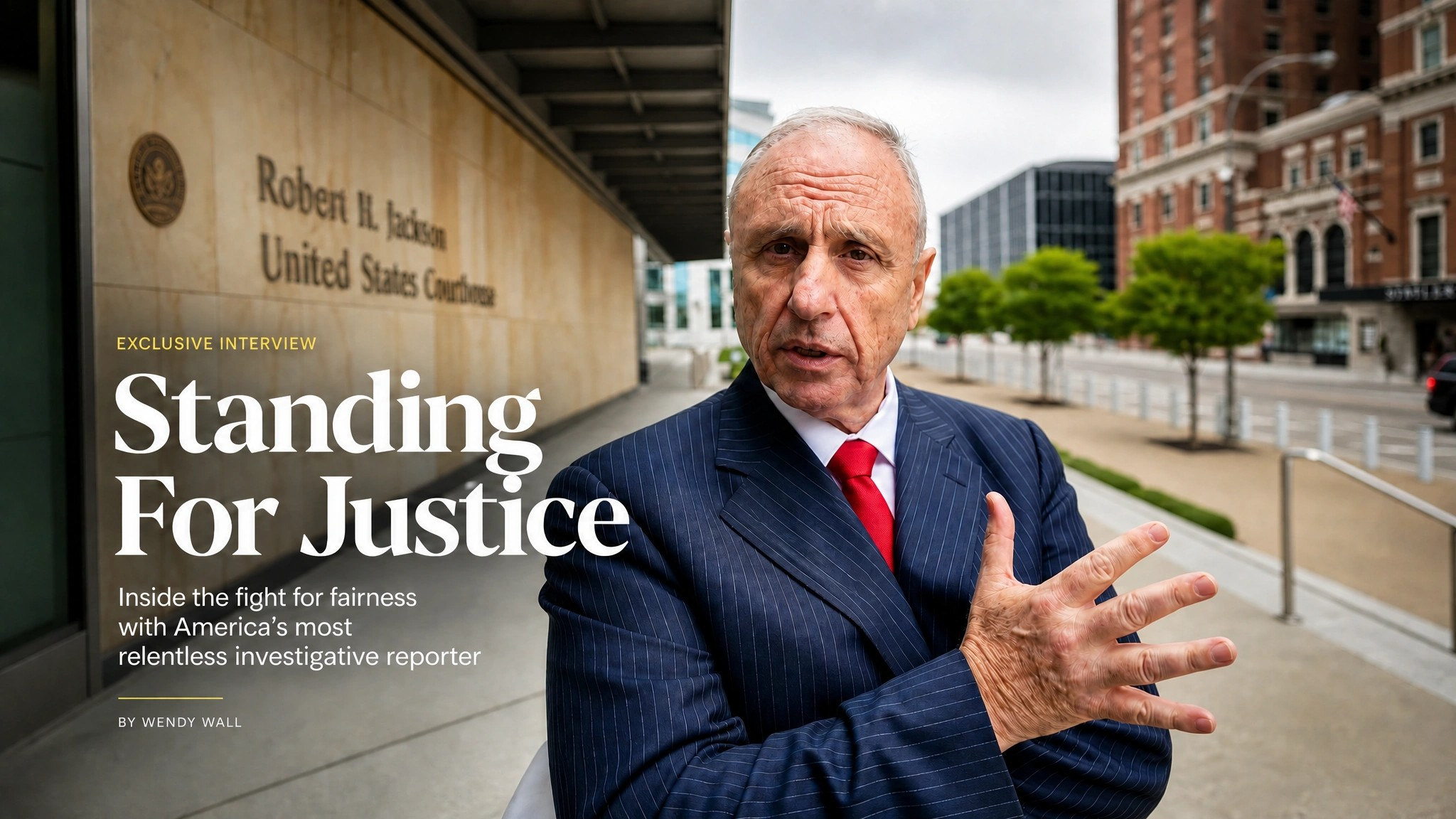
Frank Parlato is the kind of journalist who has built his reputation less through institutional prestige than through persistence, proximity to controversial subjects, and a willingness to pursue stories long after larger outlets have moved on.
He is best known as the publisher of the Frank Report, an investigative news site focused on corruption, criminal justice, cults, family court, and other contested areas of public life. Parlato also publishes Artvoice and the Niagara Falls Reporter, giving him a footprint that spans both local Western New York journalism and national investigative reporting. Artvoice alone currently lists more than 2,000 articles under his byline.
His defining journalistic chapter is unquestionably NXIVM.
Parlato was initially hired by NXIVM in 2007 as a publicist. After becoming convinced that founder Keith Raniere and members of the organization were engaging in misconduct, he became one of its most relentless critics. His reporting later focused on the secret women’s group DOS, its master-slave structure, blackmail practices, and human branding. Parlato’s own archive credits his June 2017 reporting with breaking the branding story, and his work was subsequently cited or referenced by major outlets including The New York Times, Rolling Stone, People, Vice, Fox News, and others.
His role in exposing NXIVM also carried into television and documentary work. Parlato appeared in HBO’s The Vow, Starz’s Seduced: Inside the NXIVM Cult, and Investigation Discovery’s The Lost Women of NXIVM, where he served as lead investigator and coordinating producer. Actress Catherine Oxenberg, whose daughter India became deeply involved in NXIVM, credited Parlato prominently for helping bring attention to the abuses inside the organization.
That history helps explain the unusual position Parlato occupies today. He is not simply a commentator on NXIVM; he became part of the history of the story itself.
An unconventional investigative style
Parlato’s reporting style is unusually personal and adversarial. His stories often name individuals directly, reproduce court filings and source documents, challenge official narratives, and openly tell readers what he thinks the evidence suggests.
That approach can make his work compelling, but it also makes him controversial.
Unlike the more restrained institutional voice used by traditional newspapers, the Frank Report frequently blends:
investigation,
analysis,
argument,
source documents,
and commentary.
Parlato has acknowledged that he did not come to journalism through the traditional career path. His background included business, real estate, publishing, and political/media consulting before investigative journalism became his principal public identity.
That outsider status arguably became part of his advantage. Parlato has often pursued subjects that conventional news organizations considered too obscure, messy, litigious, or time-consuming.
His current work reflects the same approach. Recent Frank Report stories have investigated alleged Justice Department misconduct, federal prosecutions, financial transactions, corporate bankruptcies, surveillance, OneTaste, and disputed criminal cases.
Western New York roots
Long before Frank Report became nationally associated with NXIVM, Parlato was deeply involved in Western New York publishing.
He became publisher of the Niagara Falls Reporter, a publication known for aggressive coverage of local government, politics, development, public contracts, and corruption. The Reporter has historically focused on Niagara Falls and Niagara County and has been described as an investigative and opinion-driven publication.
One recurring example cited by Parlato’s supporters is his reporting on the Maid of the Mist concession at Niagara Falls. His reporting challenged the structure of the longstanding boat-tour arrangement and scrutinized the relationship between the operator and government authorities. A 2015 Artvoice profile credited his investigative work with helping bring greater public attention to the concession and subsequent competitive bidding.
Parlato also became involved with Artvoice, the Buffalo alternative weekly founded in 1990. Artvoice historically covered music, theater, art, local politics, development, and culture and once had significant print circulation in Western New York.
Together, the three publications give Parlato an unusually broad archive: local political investigations, culture, national controversies, court cases, and long-running investigative projects.
A journalist who became the subject of a federal case
Parlato’s own history has also intersected with the criminal justice system he frequently covers.
He was federally indicted in 2015 in a sprawling case tied to his business activities at the One Niagara building in Niagara Falls. The prosecution originally included numerous felony allegations. The case lasted years.
In 2022, Parlato ultimately pleaded guilty to a single felony count involving his failure to file IRS Form 8300 after receiving reportable cash payments. In 2023, U.S. District Judge Richard Arcara sentenced him to time served, one year of supervised release, and five months of home confinement rather than prison.
The prosecution and Parlato sharply disagreed over how the larger financial history should be characterized. Federal prosecutors argued at sentencing that his conduct reflected broader tax misconduct, while Parlato and his attorneys emphasized that the plea itself concerned the Form 8300 violation and contested the government's broader characterization.
That episode is significant because it complicates any simple portrait of Parlato as either heroic investigator or reckless provocateur. He has spent years investigating government prosecutions while simultaneously experiencing a prolonged federal prosecution himself. That experience appears to have influenced his increasing interest in prosecutorial power, wrongful convictions, due process, and the conduct of federal agencies.
What makes Parlato important
Parlato’s strongest journalistic asset may be depth rather than breadth.
On subjects such as NXIVM, he accumulated years of reporting, documents, sources, personal relationships, court records, and institutional memory. When a new development occurs, he often has access to a historical context that a reporter arriving fresh to the story does not.
That kind of accumulated knowledge matters increasingly in an online environment filled with rapid summaries and rewritten news.
The value of an investigative archive is not simply the number of articles it contains. It is the web of relationships among:
people,
organizations,
court cases,
documents,
claims,
dates,
and earlier reporting.
That is particularly evident in Parlato’s NXIVM coverage. Other journalists reported important parts of the NXIVM story before and alongside him, but Parlato developed an unusually sustained body of reporting and became deeply embedded in the network of defectors, critics, litigants, and participants surrounding the organization.
The controversy is part of the story
Parlato is not a conventional consensus journalist, and portraying him as one would miss much of what makes him distinctive.
His reporting can be highly opinionated. He sometimes takes explicit positions on the innocence or guilt of people whose cases he investigates. He has made enemies among subjects of his reporting. His publications have occasionally drawn criticism over journalistic methods and presentation.
But that same willingness to take a position is part of why people who believe institutions have failed them often seek him out.
The resulting body of work occupies an unusual space between traditional investigative journalism, advocacy journalism, document analysis, and independent media.
The next chapter
Today, the Frank Report is evolving beyond the subject that originally gave it national prominence.
NXIVM remains part of the publication, but Parlato is increasingly writing about criminal prosecutions, alleged miscarriages of justice, government agencies, family courts, financial investigations, and cases in which he believes the accepted narrative deserves another examination.
Whether readers agree with his conclusions or not, Parlato’s career demonstrates something increasingly rare in digital media: a willingness to spend years following the same complicated subjects.
His greatest strength is not neutrality in the traditional newspaper sense.
It is persistence.
Parlato tends to keep digging after the initial headlines disappear. He accumulates documents. He develops sources. He revisits previous assumptions. And when he believes the evidence points somewhere different from the prevailing narrative, he is generally willing to say so plainly.
That approach has produced controversy, legal battles, national media attention, influential reporting—and, most notably, a body of work on NXIVM that became part of the historical record of the organization’s downfall.
Frank Parlato is therefore difficult to classify simply as a publisher, blogger, activist, or investigative journalist.
He has elements of all four.
What is clearer is that over the past decade he has built a substantial independent reporting archive and established himself as a persistent, unconventional investigative voice—particularly on subjects where he believes powerful institutions, prosecutors, courts, organizations, or the media itself have failed to tell the whole story.