The OneTaste Trial: They Got Their Witch
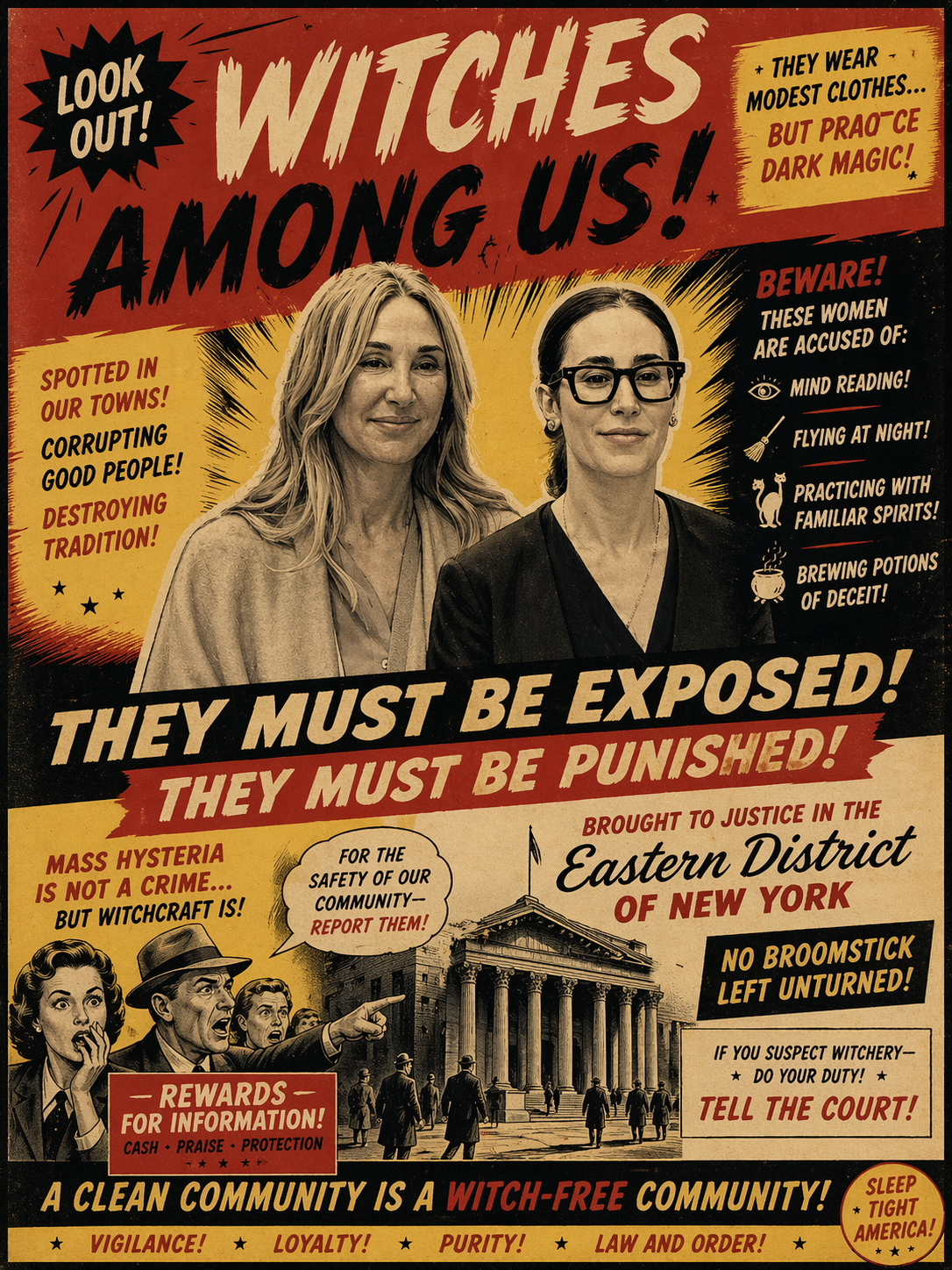
Rachel Cherwitz and Nicole Daedone (witches)
Nicole Daedone and Rachel Cherwitz ran a San Francisco company called OneTaste that focused on sex and enlightenment. Sixteen thousand people took courses.
Years later, they found themselves in a federal courtroom not in permissive San Francisco but in Brooklyn, where the rules are older, colder, and less forgiving.
The United States put them on trial for conspiracy to commit forced labor. Not forced labor. But the idea of it. The planning of it. Not the execution.
It was as if they had planned to be witches, but the charms and the jinxes didn’t work, or, if they worked, the government did not want to prove it.
The act was not on trial. Only the planning of it.
The government said, “We’re not saying you forced anyone to work. We’re saying you conspired to do it.”
On March 30, 2026, Judge Gujarati sentenced Daedone to nine years and Cherwitz to six and a half.
Salem Had a System That Worked
A number of women were convicted and executed as witches in Salem and elsewhere in colonial America, England, Europe, and Africa. There is now some doubt about the merits of the prosecutions’ cases.
Back in 1692, in Salem, they had a system that worked beautifully — if your goal was to prove that someone was a witch.
Here is how it worked: If a woman confessed, well, there you are. She was a witch.
If she denied it, that was even better. Because only a witch would lie about being a witch.
Either way, they got their witch.
It was efficient. It saved time. It spared everyone the inconvenience of doubt.
There was no testimony that could get in the way, no pathway to innocence. Heads, they win, tails, you’re a witch.
It was structured to ensure a straight road to “guilty.”
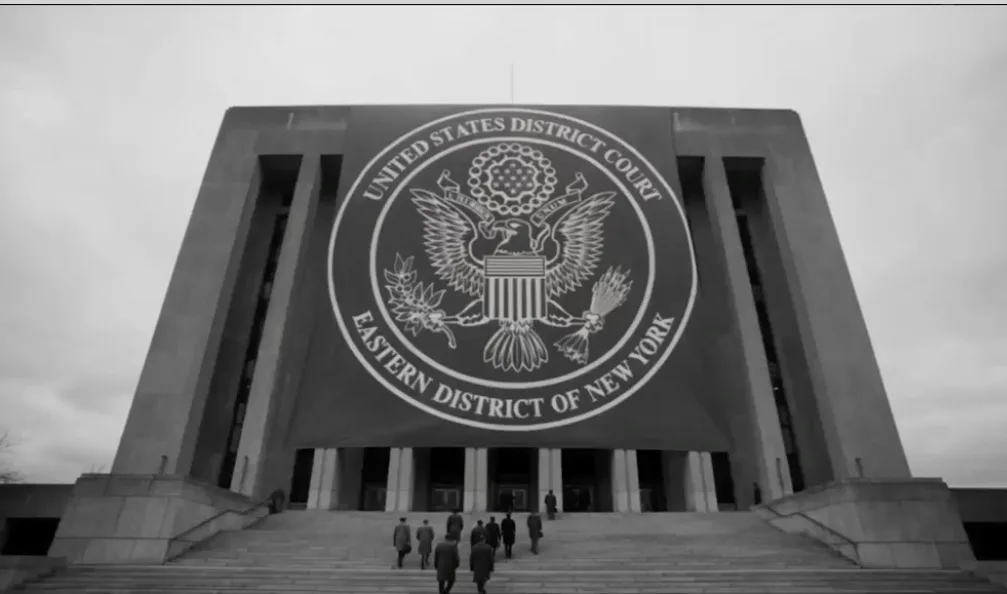
Three hundred and thirty-three years later, it wasn’t Salem. It was the Eastern District of New York. Nicer building. Women prosecutors in nicer suits. Woman judge. Women defendants, women victims.
All women on women.
Same human instincts.
The case was against Rachel Cherwitz and Nicole Daedone. And they brought back the old. Witches, they were, and witches they were presented to be before the confused and timid jury.
A Hundred Percent. Absolutely.
Michal Neria claims witchery
One of the witnesses, the beguiled if not beguiling Michal Neria, explained to the jury that “Rachel Cherwitz was known as, like, a witch and having witchy tendencies, so she knew things that we didn’t know or she could make things happen.”
A witch. Yes. Not the broomstick kind, maybe—but the kind who knew things, could make things happen. She had a little extra something.
And this is the sort of testimony that, depending on the century, either gets a laugh or gets entered into evidence.
The defense asked an obvious 21st-century question.
Q: “You think that they thought they were actually witches?”
Neria “A hundred percent. I don’t think it, I know it.”
Q: “That they are witches?”
A: “That they thought they were witches.”
Neria named the witches, the defendants, Daedone and Cherwitz, and other women of OneTaste. Each of them, Neria testified, believed herself to be a witch.
Muggles and Other Outsiders
Becky Halpern spotted witches
Another witness, impressionable if not bewitched, Rebecca Halpern, took the stand and brought literature into it. Not the serious kind. The kind with wizards.
She said the people at OneTaste called outsiders “Muggles,” which, if you’ve read the Harry Potter series, means non-wizards. Regular people. The poor souls without magic.
On its surface, it seemed a borrowed metaphor. A cultural reference. Harmless, even playful. Listen more closely.
Halpern said, “It basically means, like, they’re on the outside, we’re on the inside. If you interact with them, you are doing something potentially dangerous that’s going to affect your journey. And so I really started to believe that.”
She came to believe that being around outsiders was dangerous. Bad for her “journey.”
It’s the sort of thing people say in groups all the time. Clubs. Companies. That’s the kind of thing groups do. Everybody’s got a nickname for the people not in the club. Frats do it. Corporations do it. Countries do it. “We’re the insiders, they’re the idiots.”
On its face? It’s a joke. A metaphor. Cultural shorthand.
But in a courtroom, it stops being talk. It starts sounding like a diagnosis.
She says she started to believe it. That being around regular people—Muggles—was dangerous.
Out in the real world, people say stuff like this all the time. Diet cults. Tech companies. Political parties. Yoga retreats. “Don’t listen to outsiders, they’ll mess up your path.”
Same words. Different room. And in that courtroom, words start doing a lot more work than they were ever meant to.
A Sexy Witch from the Airport
Christina Berkeley, a sexy witch
The government had an email from Rob Kandell, who described a man arriving in New York.
“Mr. Jones arrived well and was greeted by a sexy witch who entertained him on the ride into NYC. A good time was had by all.”
“A good time was had by all,” is the sort of thing people say when they mean nothing serious at all.
Kandell explained. It was just a staff member. A ride from the airport. No broomsticks. No cauldrons bubbling in the back seat.
Then came the defense’s question.
Did he understand that Rachel Cherwitz was not an actual witch?
“Yes,” he said.
Which was helpful. It means we are all still living on the same planet.
And yet the word stayed in the room.
Another piece of government evidence. A text message. Joanna Van Vleck texting Rachel Cherwitz:
“Lady, we need to witch some shit. Can you help?”
Now that sounded promising if you’re in the witch-hunting business. But it turned out to be about concert tickets. They had been purchased incorrectly. The seats were wrong, or the date was wrong.
The “witching” required was calling the box office. No spells. No incantations. No contact with the invisible world. Just hold music. A phone call and patience.
Hogwarts, with Acid (Sober)
Anthia Gillick was bewitched
Another of the afflicted girls, Anthia Gillick, explained how she got spellbound.
“She called the coaching program Hogwarts, and said that they were witches who liked to trip acid sober, and the whole thing sounded amazing and appealing, and I signed up.”
They said they were witches. Not the burning kind. The joking kind. The kind adults invent when they’re trying to make something feel larger than it is.
They said they liked to “trip acid sober,” which sounds impressive until you realize it doesn’t require acid.
People join things for reasons like that all the time. Names. Stories. The promise of being part of something different. It doesn’t take magic.
By the time the defense got its turn, the word had been said enough times that it had started to sound almost normal.
Witch.
Didn’t Know You Were at the Brooklyn Witch Trials
Jennifer Bonjean defense counsel for the Brooklyn witch trial
Jennifer Bonjean stood up and reminded the jury that Michal Neria had said—without blinking—that they believed they were witches. One hundred percent. Absolutely.
Then Bonjean asked the only question left worth asking.
“Didn’t know you were at the Brooklyn witch trials, did you?”
Which is funny, until you realize she wasn’t joking.
Bonjean said of Neria, “This is the woman who, if you recall, thinks they were all witches or that they said they were witches. And when I asked, I said, do you really think that they think they’re witches? 100 percent. Absolutely.”
Witch trial prosecutor Kayla Bensing
Prosecutor Kayla Bensing stood up and told the jury that the defense had mocked Michal Neria for saying the defendants thought they were witches.
“They stood up in their closing arguments and mocked Michal Neria for her testimony that the defendants considered themselves to be witches. Members of the jury, the defendants made her believe that. They targeted somebody who would believe that. They are the ones who went after women with trauma and then used it. Women who would be susceptible to psychological abuse.”
The government’s rebuttal did not dispute that Neria’s testimony was facially absurd.
“They made her believe that,” she said of those in thrall. “They targeted someone who would believe that.”
The government’s rebuttal accepted that Neria was absurd and argued that her absurdity was evidence of the defendants’ guilt.
A Brilliant Arrangement
It is a brilliant arrangement. If the story sounds reasonable, it proves something happened.
If the story sounds unreasonable, it proves something happened, too.
Either way, you don’t have to worry about the story. You never have to worry about whether the testimony makes sense. If it does, you win.
If it doesn’t, you win again.
You don’t need a third option.
The defendants had, the government argued, produced in Neria the cognitive state in which she would testify, in federal court, under oath, that her former colleagues literally believed themselves to be witches.
It was as though she were possessed.
The absurdity was not a problem for the government. Neria, a college-educated, affluent white woman, the daughter of a famous college professor, was ensorcelled.
In most trials, if a witness says something ridiculous, the case gets weaker.
But here, something different happened. The stranger the testimony sounded, the better it fit.
Testimony that would normally weaken a case strengthens it.
Progress
Witch trial presiding Judge Diane Gujarati
In the end, Daedone and Cherwitz were convicted, not for forced labor but for their covenant: They conspired to force labor by such means as witchcraft.
It ended less dramatically than it did in the good old days.
Nobody was hanged. Nobody was burned at the stake. Judge Gujarati sentenced Nicole Daedone to nine years. Rachel Cherwitz got six and a half.
The elect have improved greatly in three hundred years.
The punishment for maleficium, for bewitching and beguiling credulous, malleable, soft-headed, college-educated white women, is no longer death. It is years in prison.
Progress.
See Also
They Convicted OneTaste. Trump’s Communities Are Next
OneTaste Verdict: How Forced Labor Conspiracy Theory Redefined Consent and Coercion
ARTVOICE ART
The judge and the prosecutor worked well together
Ladies and gentlemen of the jury, they are witches!
This is my little witch-believing witness Michal Neria.
Michal Neria says “Witch you!”
Which is a witch?
Who are you?