How Prosecutors Took Control of Their Sandusky Witness and His $20 Million

March 11, 2026

PROSECUTORS BUILT A FINANCIAL TRAP AROUND SANDUSKY ACCUSER AND HIS MOTHER

The Jerry Sandusky case has been presented as a story about children and a predator. But buried in a cache of newly obtained emails, bank records, and trust correspondence is a story about money, control, and two prosecutors who set up a financial trap to keep their own witness from telling the truth.

Senior Deputy Attorneys General Frank Fina and the late Joseph McGettigan didn’t just prosecute Jerry Sandusky. After the conviction, they took control of the trust created from the civil settlement paid to key accuser, Sebastian Paden.

What Paden Said Under Oath

At trial, McGettigan asked Paden whether he had a lawyer.

“No,” Paden said.

McGettigan pressed: Did his mother tell him she was going to get a lawyer?

“No,” Paden said. “You’re my lawyer.”

McGettigan responded: “Are you going to pay me?”

“Yeah, I’m going to try,” Paden said.

The jury heard it. McGettigan moved on.

The Referral Pipeline

Paden got the biggest settlement and the least control

During or immediately after the criminal prosecution, McGettigan referred Paden to civil attorney Dennis McAndrews. McAndrews referred Paden to civil attorney Stephen Raynes. On April 28, 2015, Penn State paid Paden $20 million.

McGettigan left the Attorney General’s Office on April 11, 2013 — less than a year after the June 2012 conviction — and joined McAndrews Law Offices in Berwyn, Pennsylvania.

The Twin Trusts

The day before the settlement was paid, on April 27, 2015, McAndrews — now McGettigan’s law partner — sent an email to Paden’s mother, Marie. The email spelled out the financial plan.

Paden would receive his settlement through an irrevocable trust administered by Susquehanna Trust. Marie would receive a separate $600,000 trust, funded from her son’s trust.

Marie’s trust would pay her $1,000 per week for two years. After that, all distributions would be at the trustee’s discretion.

McAndrews then imposed a gag. “Because the settlement is highly confidential, and we are all legally bound by this confidentiality,” he wrote, Marie was legally prohibited from disclosing the financial arrangements.

Marie had no independent counsel. She did not understand the trust structure — “not sure what to do next with it,” she wrote. She told McAndrews: “I do trust whatever you did to set things up.”

The Protective Committee
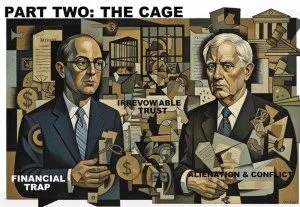
They had something in mind and it was not justice

Paden’s trust was controlled by a Trust Protective Committee, which had veto power over all distributions exceeding $100,000 per year. Committee members could not be removed without a court order. They received a guaranteed minimum of $5,000 per year, plus hourly compensation and expense reimbursements paid from Paden’s trust.

The committee consisted of three members: Frank Fina, the Senior Deputy Attorney General who co-prosecuted Sandusky; Gay Warren, McGettigan’s wife; and Lauren Cliggett, Paden’s therapist.

Paden received $1,000 per week from his trust — later raised to $1,500 per week. On a trust valued at more than $10 million, Paden was receiving less than one percent of his own money per year.

Fina Embedded in Marie’s Finances

In March 2017, Marie asked the trust about purchasing a house. On March 22, 2017, Stephanie Reece, Vice President and Personal Trust Specialist at BB&T Wealth — the successor to Susquehanna Trust — informed Marie that the trustee had sole discretion to spend up to $200,000 on a residence. She then added, “I’d also speak with Frank about it. I know he’s very helpful with these types of decisions.”

The “Frank” was Frank Fina, the prosecutor in the case.

Marie replied the same day: “Frank has the info.”

The institutional trustee of a federally regulated financial institution was treating the prosecutor as the appropriate decision-maker regarding the witness’s mother’s personal housing decisions five years after the trial ended.

The Financial Cliff

Two men kept control of Paden with the unfullfilled lure of wealth in return for perjury

On April 30, 2017, Marie’s guaranteed $1,000 weekly payments stopped, exactly as the trust had designed. She was now dependent on discretionary distributions from a trustee who deferred to Fina.

Marie’s bank records document the transition. In April 2017, she received two trust deposits totaling $3,183.58. By May 2017, she was transferring $200 from her personal savings account to sustain herself.

On June 1, 2017, the trustee demanded that she submit a written household budget and income documentation before further distributions would be considered. “Unfortunately,” Reece wrote, “we may have difficulty considering any further distributions until we receive the requested budget.”

The mother of the witness whose testimony helped generate a $20 million settlement submitted a resume in response. Her work history: bartender and cook at Henry’s Suds and Subs in Lewistown from 2003 to 2005; manager of the Major League Sports Bar from 2005 to 2011; housekeeper in Jupiter, Florida, from 2014 to 2016.

The Patronage Network

Sandusky Paden Mcgettigan Fina Skerda ART

While Marie submitted a bartender’s resume for permission to pay rent, Paden’s trust funded an expanding network of paid positions — all selected by people connected to the prosecution team.

The network included Trust Protective Committee members Fina, Warren, and Cliggett; Chris Malanga, a power of attorney and life coach who later said of Paden: “You’ve made me so much money, buddy!”; Zachary Weinzetl, a life coach who moved into Paden’s home and slept on the couch; multiple 24/7 therapists, some living with Paden; a retired police officer serving as a security detail; a team leader named Lindsay managing nannies — whom Marie reported to the trustee as never present and overpaid; nannies and doulas; and the Wind Horse therapeutic facility billing for daily sessions.

In June 2017, Marie reported to the trustee that the Colorado team was “overpaid for stuff they aren’t doing” and that “there is a lot of waste going on.” The trustee overruled her. The team stayed. The billing continued.

The Attempt to Escape

In September 2020, Marie contacted an independent attorney, Sarah Brooks, in Colorado to review the trusts. Her email to Brooks said: “How can we get rid and away from all fraud aspects of this.” She reported that Paden was being charged $4,000 per month in rent for a house he believed he owned. She asked for help to “get away from these people.”

Brooks analyzed the trusts and responded on September 22, 2020. Both trusts could not be altered, amended, revoked, or terminated — except by the trustee with the Trust Protective Committee’s approval, by court order, or by Paden’s written request with the committee’s agreement. Options one and three required the consent of Fina and Warren — the very people Marie sought to escape. Option two required litigation she could not afford. Brooks quoted a $3,000 retainer.

The woman who had transferred $200 from her personal savings three years earlier to pay her bills could not fund the litigation to free her son from the trust controlled by the prosecutors.

The Alienation

According to Marie, McGettigan told Paden that his mother was “batshit crazy.” The Colorado team — installed by Fina and Warren, paid by the trust — isolated Paden from Marie. In a September 2018 email to life coach Weinzetl, Marie wrote: “I find myself trapped under Sebastian’s bullshit… I thought this money was to help Sab and not help everyone else.”

By June 2022, the alienation was complete. When Marie asked to see her grandchild, Paden replied: “Leave My family alone… you’re a horrible person… you’re that evil of a person so good luck have fun with your life goodbye mother.”

Marie was now entirely cut off from him.

What the Judge Didn’t See
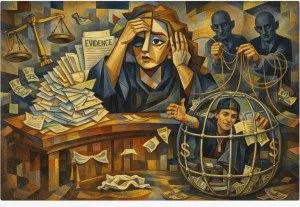
The judge chose not to look at the witness in the trap

Judge Maureen Skerda dismissed Sandusky’s PCRA petition on February 27, 2026, without the Rule 907 notice required by Pennsylvania criminal procedure. The financial evidence detailed here was being prepared for inclusion in an amended petition at the time of dismissal.

The financial trap was not trial evidence. It was the mechanism used to prevent post-trial evidence — recantations — from reaching the court. That is the definition of governmental interference.

The trust alienated Paden from his mother. Paden ultimately lost custody of both his children — one in foster care, one with an estranged mother. The prosecutors who built the cage around their witness retained control of his millions long after their work was done.

See also: The 25 Minutes That Could Free Jerry Sandusky

Judge Skerda’s Lawless Dismissal of Sandusky PCRA: A Ruling Designed to Run Out the Clock on a Man She Hopes Will Die in Prison 

author avatar
Frank Parlato
Frank Parlato is an investigative journalist, media strategist, publisher, and legal consultant.
3.7 3 votes
Article Rating

Please leave a comment: Your opinion is important to us!

Subscribe
Notify of
guest

17 Comments
Newest
Oldest Most Voted
Inline Feedbacks
View all comments
Anonymous
Anonymous
1 month ago

(3) Just as concerning is that not only does the Board hide information from the public and deliberate in private, Board leadership even hides information from some trustees who are merely trying to fulfill their fiduciary responsibilities.

— Nothing but low life scum bags that sit on these corrupt boards and play games of hiding information/evidence from each other.

Special Interests agendas are what’s priority in Pennsylvania.

https://www.statecollege.com/articles/opinion/op-ed-5-reasons-to-worry-about-how-penn-states-board-of-trustees-university-leadership-continue-to-conduct-business/

Op-Ed: 5 Reasons to Worry About How Penn State’s Board of Trustees, University Leadership Continue to Conduct Business

By
Alvin de Levie

March 19, 2026 – 1:52 pm
Latest Penn State News, Opinion

I was quoted in a column in October 2024 when I stated the Penn State Board of Trustees and university leadership had lost their way. Sadly, it has only gotten much, much worse.
(1) In a brazen and unprecedented attempt to circumvent and in defiance of the Pennsylvania Right To Know Law (RTKL) and in an attempt to hide from the public communications sent to trustees who were state agency secretaries appointed by the governor, it was suggested and discussed by trustees that such emails be sent only to their private email addresses, not to their official state email addresses, all in the hope that those emails would not be subject to a RTKL request.

It was also suggested and discussed by trustees that information sent to those secretaries also be sent through Diligent, a cloud based platform, again in a calculated attempt to shield such communications from a RTKL request. I personally heard all this from board members while I was on campus for a board meeting. At the time, I was a member of the Penn State Board of Trustees.
The Pennsylvania Commonwealth Court wholly rejected this attempt by Penn State, noting that ruling otherwise “would perversely incentivize Commonwealth agencies, local agencies and affected third parties like Penn State to utilize remote servers and/or cloud-based services, in order to ensure that they would no longer need to disclose what would otherwise constitute public records.”
To allow Penn State to utilize remote and/or cloud-based services would enable the university to dodge Pennsylvania transparency laws. Sadly, but not surprisingly, Penn State and the Pennsylvania Department of Education sought review of the decision in which the Commonwealth Court ruled Penn State cannot shield records from the public simply by storing them in a file-sharing system or alleging they contain proprietary information.
In the petition to the Pennsylvania Supreme Court seeking review of the lower court decision, Penn State claimed that although the secretaries had access to and could review the records on the cloud-based server, that the gubernatorial appointed trustees actually never received the records. HUH?
So although those trustees had access to the records, could read them, think about them and read as many times as they wanted to, they never possessed them? HUH?
Penn State claimed that since the materials on the server could not be “xeroxed,” to use an ancient term, the trustees appointed by the governor did not possess the records and were therefore not subject to a RTKL request. And yet, it was common practice for trustees to have “xeroxed” copies of the documents before, during and after trustee meetings. So the Penn State argument is fatally factually and legally flawed.
Sadly, Penn State revoked access by the governor’s appointees to the online file-sharing platform. To the best of my knowledge, there has been no explanation by the Penn State administration, by the Board of Trustees or by the individual secretaries whose access has been revoked whether they have otherwise been provided the materials necessary for them to conduct university business. If not, what are the ramifications of these trustees not having access to the information necessary for them to fulfill their fiduciary responsibilities? And if they received the records, how and when did they?
(2) After years on the Board, either former Board of Trustees Chair Mathew Schuyler did not know about and did not have the foggiest or faintest understanding of how and why the Pennsylvania Sunshine Law applied to Board deliberations, or worse perhaps, he knew, but did not care and/or felt the Board was above the law.
The Sunshine Law required the Board to fully deliberate IN PUBLIC — not behind closed doors in executive session with debate hidden from the public — before it voted on the $700 million appropriation for the renovation of Beaver Stadium, which many times has been referred to by the university as the largest appropriation in Penn State history.
Due to the significant public interest and the magnitude of committing Penn State to a $700 million obligation (at the time I was a member of the Penn State Board of Trustees and chair of the Legal and Compliance Committee), I explained to former Chair Schuyler the Board needed more time to deliberate IN PUBLIC. Chair Schuyler did not heed my advice and cut short public deliberation, stating the Board had ample time to deliberate in executive session… meaning in private, behind closed doors, hidden from the public.
Spotlight PA (an independent newsroom in Pennsylvania, focused on investigative and public service journalism) cited the conversation between myself and former Chair Schuyler in a lawsuit it filed alleging the Board of Trustees violated the Pennsylvania Sunshine Law. Rather than face certain public ridicule and scrutiny from an adverse court decision, the Board agreed to send all of its members to school to be taught the importance of and why the Board must comply with the Pennsylvania Sunshine Law.
Well, I was not on the Board when trustees “went to school” to learn about why it is important for them to adhere to the Sunshine Law. Isn’t it sad and disappointing trustees even had to “go to school” to learn about the importance of public deliberation and the applicability of the Pennsylvania Sunshine Law?
So why is public deliberation, discussion and debate by the Board critical? This issue was discussed and addressed in a recent Spotlight PA story. It quoted a statement of Ross Mugler, interim president and CEO of the Association of Governing Boards of Universities and Colleges: “Public discussion can improve trust and help leaders make better decisions. When board members spend meaningful time in discussion, institutions benefit from the candid dialogue and healthy skepticism that occurs before final decisions are made. Quick approvals without inquiry fall short of fiduciary duty. Leaders must encourage questions, test, assumptions, and explore alternatives before decision-making.”
(3) Just as concerning is that not only does the Board hide information from the public and deliberate in private, Board leadership even hides information from some trustees who are merely trying to fulfill their fiduciary responsibilities.
An alumni-elected trustee asked Board leadership for information regarding Penn State’s approximate $5 billion endowment because of his concerns regarding expenses charged by endowment managers, and the performance of the endowment investments. One of the trustee’s concerns was that management costs and fees had tripled. This trustee wanted to examine records, including an IRS form, to see if there was an explanation.
Maybe there was a good explanation; maybe not. But that really doesn’t matter one way or the other. It is pretty straightforward: The trustee was entitled to review the documents he requested. If there was a problem with the endowment, all the better to find out. If there was no problem, all the better.
The trustee also sought documents regarding the university’s award of a contract to Elevate Sports Ventures, a professional ticketing sales agency for Penn State football games.
Board leadership and the chair of the finance committee refused to give the information to their colleague even after the trustee asked for the information about a half dozen times. So in July 2024, the trustee filed suit in Centre County Court requesting the information in accordance with state law. Finally, in February 2025, Board leadership agreed to give their fellow trustee the information that they themselves certainly had access to.
I am certainly not privy to what any review of those documents revealed. But regardless of what a review of the financial documents and contract revealed, the documents should have been released to the trustee without the necessity of his filing suit.
(4) Has board governance overall become more transparent? Sadly, no. While the Penn State Board of Trustees has actually spent more time discussing certain university business in its public meetings in 2025 than in previous years, that does not tell the whole story. In those full public meetings, data analyzed by Spotlight PA reveals that all but five minutes of the board’s public conversations in 2025 were almost entirely regarding only three topics: naming the field at Beaver Stadium; removing a sitting trustee from the board who requested information regarding the university endowments, ostensibly for other reasons; and closing seven branch campuses.
From review of the Board’s full public meetings in 2025, Spotlight PA found such topics as the Penn State strategic plan, the university’s annual operating budget (about $10 billion) and President Neeli Bendapudi’s compensation package and raise of approximately $1 million received 29 seconds of public discussion.
In all fairness to the board, in addition to full public board meetings, committees meet in public sessions where various matters are certainly discussed. But again, that does not tell the whole story. In those public committee meetings, committee members, who are handpicked by the board leadership, can ask questions, and when and if time permits, other trustees can ask questions, BUT only if called upon by the Board chair.
And if you believe the full board met extensively in public in 2025, you would be wrong, again. According to an analysis conducted by Spotlight PA, the full board met in public nine times in 2025 for a total of approximately 10.5 hours.
The Board acts as if it is a privately owned and closely held corporation, which owes no accountability to the public, the constituencies of Penn State and the commonwealth that appropriates $300 million annually to Penn State.
(5) So you might hope things could not get worse. Sadly, you would be wrong again.
You might think and hope trustees who have not had a full opportunity to ask questions or have a fulsome discussion and opportunity to deliberate during public meetings could talk freely and directly with the public and/or press to express their thoughts, concerns and opinions. But censorship and Big Brother live at Penn State. Let me explain.
A recent change to the Board’s bylaws muzzles direct and unfettered communication by trustees to the university’s constituencies: the students, the staff, alumni and the entire Penn State community. The recent change states trustees “shall coordinate media and press interactions relating to matters that have come before the Board with the Board office in advance and shall respect guidance regarding such interactions that might be conveyed by them or the office of strategic communications.” In other words, say what Big Brother wants or face censure, or worse, expulsion.
So what does all this mean?
Board leadership that failed to adhere to the PA Sunshine Law, that failed to adhere to the PA Right To Know Law, that withheld information from a trustee only trying to do his job, and that restricted public deliberation regarding the $700 million renovation of Beaver Stadium has truly no shame nor accountability. Big Brother lives at Penn State.
It also means that the Board of Trustees and university leadership dictate what you know and what you hear because they want to control what you think. In the meantime, we can all look forward to the “puff pieces” trustees and university leaders routinely post on LinkedIn and other social media, while we are force-fed countless promotional articles from the Office of Strategic Communications.
SO WHAT CAN YOU DO?
Experience teaches us Penn State will not voluntarily change how they conduct business. Will contacting the Board of Trustees and university leadership change anything? Probably not. Experience teaches us they don’t care. Why do I say that? Because in 2021, the Penn State Board of Trustees banned in-person public comment and discussion. Was the criticism too strong or were they simply unprepared to answer the tough question? OR did they not want to explain what they were doing. It was just another way they could insulate themselves and not be held accountable.
This is not about politics. It’s about good governance and transparency. This is an election year. Contact the candidates for governor, state representatives and state senators repeatedly and and ask them to hold Penn State accountable by (1) amending the Pennsylvania Sunshine Law to include serious financial penalties and sanctions if Penn State does not adhere to the letter of the law; (2) amending the Right To Know Law to make it to make it more broadly, applicable to Penn State and again to include serious financial penalties and sanctions if Penn State does not adhere to the Law. AND, continue to seek accountability from individual trustees, the president and all those on the president’s council.
Alvin de Levie is an attorney and former member of the Penn State Board of Trustees.

Anonymous
Anonymous
1 month ago

“When you’ve finally had enough of the status quo and decide to become the main characters of your own neon-purple fever dream. Business as usual? Not today. We’re taking the luggage, the fur, and the first flight out of Finaville.”
Screenshot-2026-03-12-at-7-08-45-AM.png

Anonymous
Anonymous
1 month ago

McGettigan: May he enjoy the warmer climate he just relocated to.

Anonymous
Anonymous
1 month ago
Reply to  Anonymous

Sandusky is innocent. ANyone who strudies the case will see it.

Anonymous
Anonymous
1 month ago

I have been a lawyer for 22 years, and a public servant for almost all of that time. I have not retained an attorney to advise me to speak, or to remain silent. I am an attorney.

i_challenge_ag_kane_to_face_me.html

Abm
Abm
1 month ago

Sandusky deserves a new trial. Period.

Sheldon Lee Kociol
Sheldon Lee Kociol
1 month ago

Jerry Sandusky needs to be freed.

[redacted]

Sheldon Lee Kociol
Sheldon Lee Kociol
1 month ago

The fog in Salinas didn’t just roll in from the Monterey Bay; it clung to the lettuce fields like a damp shroud, turning the neon signs of Main Street into blurred, glowing ghosts. In a nondescript converted warehouse tucked between an agricultural cold-storage facility and an old rail line, Sheldon Lee Kociol adjusted his prayer shawl.
It wasn’t the traditional wool of his ancestors. It was woven from charcoal-colored silk, embroidered with silver thread that seemed to catch the light even when there was none.
Sheldon looked out over his congregation. These weren’t the “Satanists” of cinema—there were no capes or flickering torches. These were the weary and the sharp-eyed: field foremen with dirt under their fingernails, disillusioned tech commuters from across the grade, and poets who had run out of metaphors.
“Welcome,” Sheldon said, his voice echoing with a calm, scholarly weight. “Let us begin the mid-week reckoning.”
He didn’t preach about evil. To Sheldon, the “Synagogue of Satan” was a misnomer for the misunderstood—a place for the adversarial spirit, the ha-satan of the old texts who acted as the heavenly prosecutor, the one who asked the difficult questions. In the heart of the Salad Bowl of the World, Sheldon’s role was to help people harvest their own truths.
He opened a heavy, leather-bound volume. “Tonight’s reading is from the Book of Doubt,” he announced. “We live in a valley of plenty, yet we are starved for meaning. We are told to be humble, yet we are ignored. I say to you: the only sin is the refusal to see yourself as the architect of your own fate.”
The air in the room grew heavy with the smell of damp earth and expensive incense. Sheldon moved to the bimah, his shadow stretching long and thin against the back wall. He spoke of the balance between the light of the sun that grew the crops and the darkness of the soil that birthed them.
As the service ended, the congregants filed out into the chilly California night. Sheldon stayed behind, blowing out the candles one by one. He walked to the window and watched a freight train rumble past, its whistle screaming into the mist.
He allowed himself a small, wry smile. Being a rabbi in Salinas was one thing; being a guide through the shadows was quite another. He tucked his silk shawl into a velvet case, locked the heavy steel doors, and vanished into the fog, just another silhouette in the valley.

Anonymous
Anonymous
27 days ago

Danish, plagiarizing Steinbeck and impersonating someone who has nothing to do with your insanity is rich. WTF is wrong with you Danish. Don’t you have enough legal problems? I just looked up the synagogue of Satan and it’s an antisemitic book. That makes you Danish a antisemite which is a hate crime. That is beyond civil suits. I also looked up, which is public domain, all synagogues in Salinas and Monterey County. There is not one called synagogue of Satan. There is no rabbi named Sheldon Lee Kociol.
You are a sick pathetic little man Danish who is trying to get into more legal trouble. You really have a mental disorder. You are a sick pathetic coward.

Anonymous
Anonymous
9 days ago
Reply to  Anonymous

It is not Danesh, it is Samuel K from Nebraska. He is a verifiable mentally disturbed retard. He has been arrested for sexual assault of a 7 year old girl. In other words, Samuel is a verifiable pedophile. Samuel impersonates minor children on TikTok. He doesn’t have a life or job. He sponges off his wife. He is criminally insane and extremely racist.

Pimps for Paden
Pimps for Paden
1 month ago

Recently found this random photo of Jerry Sandusky at my parents house;

Score Keeper
Score Keeper
1 month ago

Yawn.

Say Hi to Jer for me!

And tell him not to drop the soap!

Anonymous
Anonymous
1 month ago

Fucking right I too hope Sandusky dies in prison or by rope of choice. I no Howard stern wants him clipped.

Anonymous
Anonymous
1 month ago

The real story here may be simpler: a huge settlement created a pool of money and a network of professionals formed around it. Therapists, administrators, trustees, advisers — everyone gets a slice. Once that ecosystem forms, nobody inside it has an incentive to question the original story that created the money.

Anonymous
Anonymous
1 month ago
Reply to  Anonymous

The system ran like a containment camp. A judge that once worked at psU then pimped to be a county Da. moved into a judge role and ran the system like a practicing lawyer. He was a crook and not the smartest of much. If you had a choice to review the cases that were botched you’d say this county combo was shit stain of fuckery.

J Moody
J Moody
1 month ago
Reply to  Anonymous

That is so interesting. Initially McGettigan’s telling young protoge’s at his law firm (as it mentions in his Obit) when they would ask if Sandusky was really guilty, he’d exaggerate “Guilty as hell!” which is the required prosecutorial attitude … even if a prosecutor has doubts. And settlement money after the trial wasn’t related to any injustice … after his wife was getting the 5K per year minimum from being a trustee, though, in videos he seems to act like he thinks JS really was guilty, and he allowed himself to forget that a *former* witness collecting settlement money is unlikely to ever tell the truth if it means the money will stop. Over time, his wife’s salary from the settlement money reduced his curiosity about the facts of the case.

Anonymous
Anonymous
1 month ago
Reply to  J Moody

I tried to find an article from wayback about the one judge connected. It was about this judge falling asleep in court. And the writer was sued and paper and I think the judge got over three hundred grand and it was shady, It was right after the judge went thru a divorce. I think he envisioned everyone naked In the room and feed his ego into thought while seated behind the bench.

Don't Miss

17
0
Would love your thoughts, please comment.x
()
x